


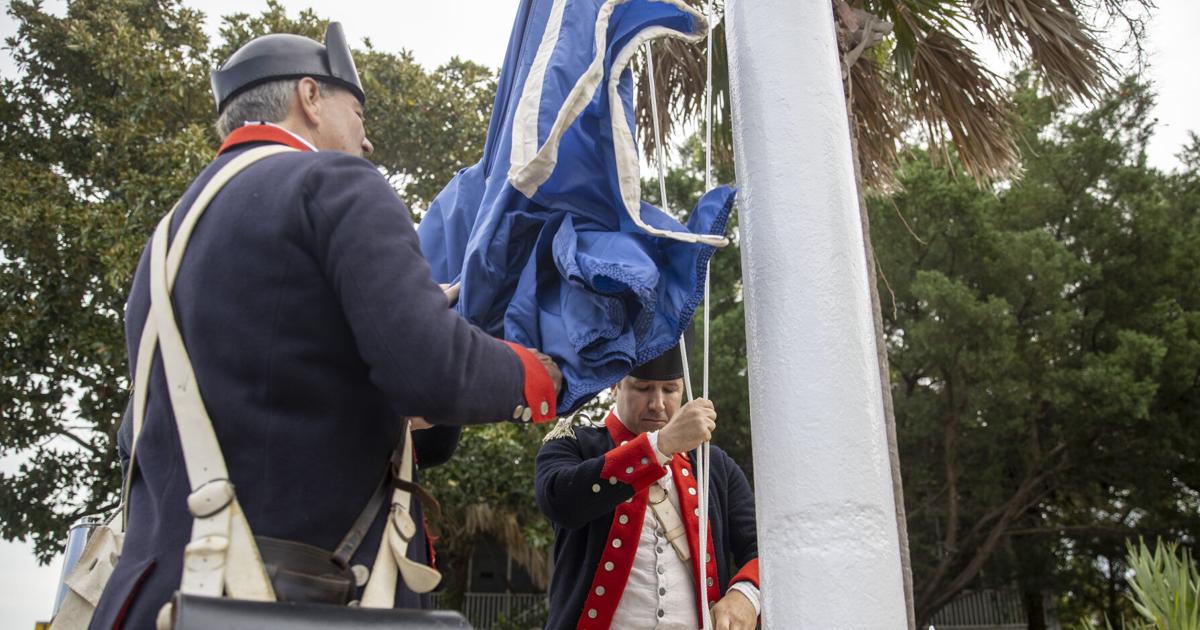
JAMES ISLAND — The flag of a Revolutionary hero was raised over Fort Johnson after patriots took it over from British forces 250 years ago. On Sept. 13, the flag rose again over the land where the fort once stood kicking off a series of events honoring the nation’s 250th birthday.
The event, hosted by SC 250 Charleston, was to mark the anniversary of the fort’s capture in the nascent days of the Revolutionary War. Erick Nason, a historian and re-enactor leading the 2nd South Carolina Regiment, recounted the daring albeit anticlimactic mission to take the stronghold and its almost 20 cannons.
Local leaders tasked then-Col. William Moultrie with seizing Fort Johnson. Moultrie and his deputy selected three companies led by men who would one day become heroes and historic names in their own right — Captains Barnard Elliott, Charles Pinckney, and Francis Marion.
Pinckney, Elliott, and Marion hand-selected the men in their companies, Nason said, pulling the best troops from other units and even going as far as Georgia to get the best men for their teams.
“What’s unique about this is there’s a lot of firsts going on before we can come over here and raise this great flag for the first time. This is the first military operation of a South Carolina unit,” Nason said. It was also an amphibious and nighttime operation, things that Nason said made the strike novel in its day, particularly given the heavily fortified target.
That night, the troops rowed across Charleston Harbor, being careful to avoid the two British ships anchored in the water. While they got past the warships, they missed their landing point, resulting in a slog through mud and shark-infested water with their boats to the shore. Hours earlier, however, British troops had toppled the cannons from their bases before leaving the fort.
When the patriots arrived in assault columns, Nason said, they were met by only a handful of British sailors. The Americans captured them and secured Fort Johnson, fixing the cannons in case of a British attack from the ships in the harbor.
But that attack ultimately never came.
“And that is when that beautiful blue flag went up, and we basically stated that this now belongs to South Carolina — our first true victory against the British,” Nason said.
That battle was followed the next year by the Battle of Sullivan’s Island, where Moultrie and his men successfully defended the island’s fort from the British and Sgt. William Jasper famously raised Moultrie’s flag above Fort Sullivan after the staff had been shot down during the battle.
The flag Moultrie designed — a white crescent on an indigo-dyed field to resemble the uniforms of his troops — became the basis for the Palmetto State’s current flag. Though, as Director Eric Emerson of the S.C. Department of Archives and History noted in his remarks, South Carolina hasn’t had a formal, agreed upon design written into state code in over 80 years.
Over the years after independence, Fort Johnson saw a visit from President George Washington and a refurbishment that saw new walls built from tabby — a concrete-like substance made from oyster shells, sand, and water. On April 12, 1861, the first shot of the Civil War was fired from Fort Johnson and exploded over the Union-held Fort Sumter, signaling for other batteries to open fire.
Today, all that remains of Fort Johnson is the stronghold’s cisterns and a powder magazine. Rick Wise, the CEO of South Carolina Battleground Preservation Trust, said he hopes to recognize the ream of his late predecessor, James Island native Doug Bostick.