


Hannah-Jones, the Pulitzer Prize-winning author of the 1619 Project and a writer for The New York Times Magazine, spoke at the Westin Copley Place during the annual Martin Luther King Jr. Memorial Breakfast in Boston. She and other speakers including Governor Maura Healey, drew contrasts between the civil rights legacy of King and the Trump administration’s actions.
The work that King fought and died for was being dismantled at a rapid pace “by the most openly white nationalist administration of my lifetime,” Hannah-Jones said.
She noted the federal government’s sweeping attacks on areas from the arts and universities, to national parks and the legal and political system. The country, she added, is unable to grapple honestly with its own history of slavery.
Many who spoke at Monday’s celebrations honoring King noted his connection to the city, where he received his Ph.D. in theology from Boston University and met his wife, Coretta Scott King.
Healey said it was a time for “collective leadership” in response to the Trump administration’s dramatic cuts and changes over the last year. Those attacks, she said, spanned the federal government’s “calculated cruelty” in cuts to SNAP benefits and health care, to its eradication of images of trailblazing Black people and other people of color from federal websites.
“We are not afraid,” Healey said. “We know what is right. We know what is wrong. We believe in the values of freedom, of justice, and we believe and know how to put those into action every day. We do this with the free, fierce urgency of Dr. King. We do this with the fierce urgency of now.”
Boston Mayor Michelle Wu, at the breakfast, also briefly referred to a more local issue — a tax proposal seeking to combat tax increases for Boston homeowners that the Massachusetts Senate shot down last week. Wu has long advocated for the state Senate to vote on the proposal, backed by the Massachusetts House, which could have shifted more of the city’s property tax burden from homeowners onto commercial properties.
“I say this with love: that we cannot let our Commonwealth, a beacon for freedom and hope and democracy, lean more on the lobbying of the Chamber of Commerce than the conscience of our cause,” Wu said, to cheers.
“We cannot let it be that our state and our community can find the funds to host the World Cup but not get worked up about our seniors not being able to stay in their homes,” Wu said.
At Boston University, the city of Boston’s official MLK Jr. Day event was centered around the theme of education. Boston University President Melissa Gilliam, in her remarks, referenced the importance of organizations such as the international aid agency USAID, which has essentially been gutted by the Trump administration. But she also called on the audience of more than 100 people to reflect on how they could work to improve their own thinking.
“Yes, we can look outward and be dismayed as the country re-litigates what we already know to be true and seeks to erase progress that we have made. There are truly societal evils, and they must be addressed,” Gilliam said.
Yet, she added, “I invite us also to ponder to what extent are these evils in our own hearts and behaviors. Do I personally practice prejudice, ignore poverty, or miss opportunities to practice peace?”
The event’s keynote speaker, Eve Ewing, a University of Chicago professor and author, referenced the detainments of immigrants across the country and the killing of Renee Nicole Good, the 37-year-old Minneapolis woman shot by a federal immigration agent earlier this month.
“How do we cultivate the fortitude needed to face a state apparatus hell bent on our destruction, even when we are afraid?” Ewing asked. “How do we turn toward and not away?”
Ewing referred to King’s sermon, “The Mastery of Fear,” saying that “if fear is a misuse of creativity that drives us to turn away, then to turn toward … we have to forge in our heads the world in which our loved ones thrive.”
In that vein, some participating in gatherings across the city said current events had pushed them to find ways to give back to their communities this holiday.
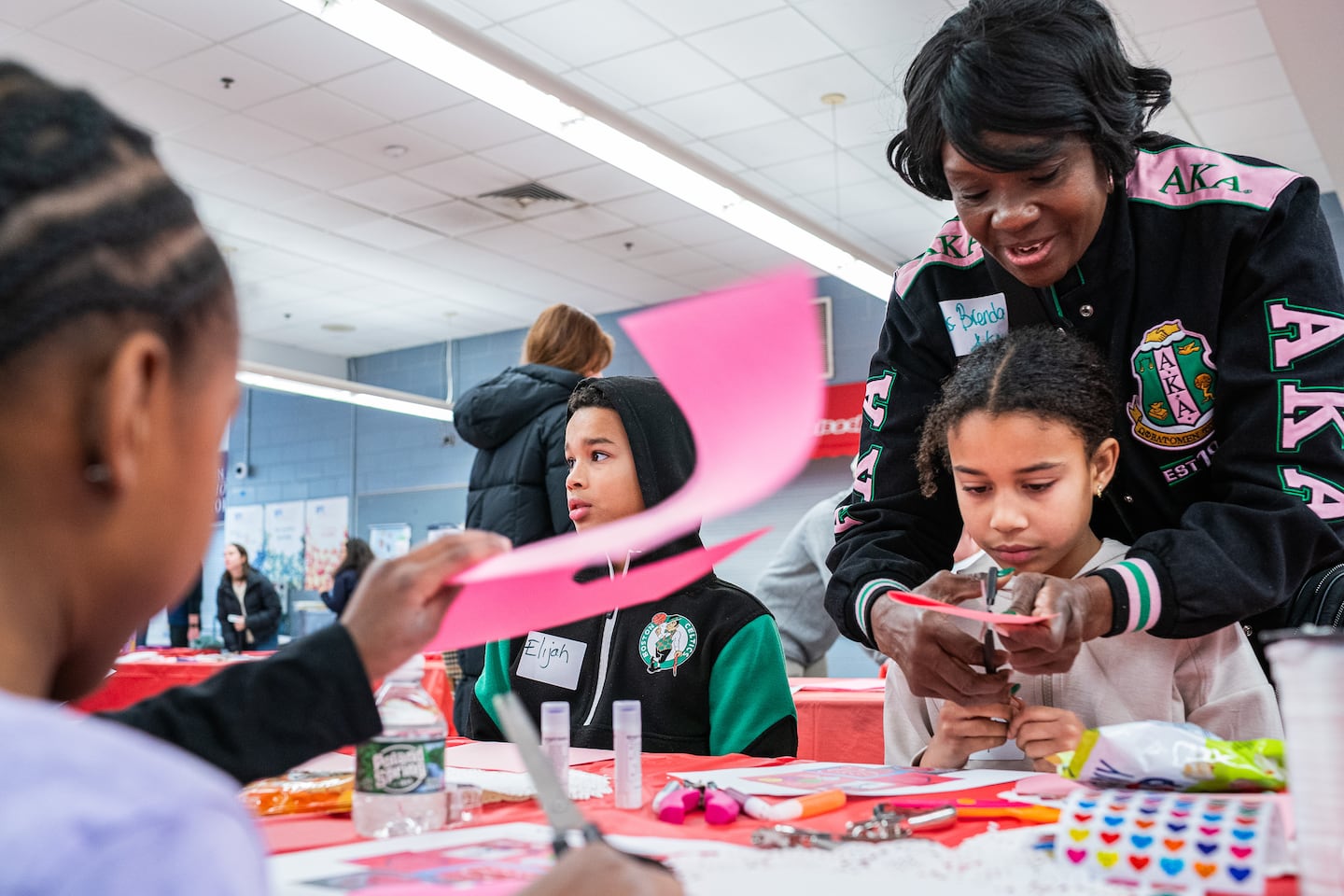
At the Boston Latin School, more than 300 people gathered for the annual MLK Day of Service organized by the volunteer agency Boston Cares. The event, which has taken place for more than 20 years, featured five projects to help local nonprofits, such as making hygiene kits for people living on the streets, crafts kits for children in homeless shelters, and Valentine’s Day cards for the elderly and disabled.
This year’s events took on more importance this year as federal funding cuts have hurt many organizations Boston Cares works with, said Boston Cares Executive Director Sara Hamilton.
“Volunteerism can’t replace everything at a nonprofit, but if we can help stop gaps and fill things in … it’s one less thing that that nonprofit has to allocate funds for,” Hamilton said.
Many volunteers, too, said the Trump administration’s cuts to social services were top of mind. Cierra Martin, 26, of Back Bay, took the day off from her job at a hedge fund to participate, saying she wanted to give back to her community.
“There’s a lot of resources being taken away,” Martin said. “I think if we just come together and support each other, we can still get that work out there.”
Carola Endicott, Boston Cares’ board chair, said the day of service was one of the largest she had ever seen. The line to volunteer stretched out the door, despite snowy, sub-freezing conditions.
“Volunteerism is on the rise. We’re seeing that,” Endicott said. “It’s an antidote to hopelessness.”