


This is an opinion column.
Where to begin with the board that decides whether you get to watch Daniel Tiger or Ken Burns’ “American Revolution,” on Alabama Public Television?
Clown car? Kangaroo court? A Monty Python sketch, as one observer of the board’s meeting put it? Sure. But that’s way too kind.
Because it’s really a Trojan Horse.
There’s no way to watch the chaos at the Alabama Educational Television Commission without concluding that the goal of those who command this board is not to make better programming, or to draw more viewers, or to help Alabama’s public TV prosper. The goal is to strip the Alabama airwaves of anything that smells more like diversity of opinion than White House fan mail.
“Removing PBS here would be a major statement as to the direction Alabama Educational Television intends to take,” Board Chairman Ferris Stephens wrote to others at APT in October, when the move to rid APT of its most viewed programming came to light. “Because the state has benefitted WAY more from Trump being happy with Alabama and our political leaders are NOT interested in pulling on Superman’s cape over PBS programming.”
He said the quiet part out loud.
In the treatise obtained by AL.com, Stephens cited President Trump’s disdain for PBS, and its purported “lack of journalistic standards,” meaning it continues to question authority when Stephens and cronies would prefer a pack of fawning kits.
So burn it to the ground, and blame it all on PBS, the company that brought you “Sesame Street,” “Frontline,” “Nature,” “Nova” and that dastardly “Antiques Roadshow.” Blame it most of all on “PBS Newshour,” that news show that corrects its errors and abides by traditional journalism methods, but tries to reach audiences of all hues and faiths, thus becoming the wartiest witch in the hunt.
The thing is, PBS — “Austin City Limits,” “Finding Your Roots” — is the reason most people who support APT open up their wallets. Donations for the current year are expected to be about $4 million, or about 35% of the budget, according to their own estimates. Those donations give viewers access to Passport and all the PBS programming. Listeners and viewers who gathered at the meeting in Birmingham on Tuesday said they would withhold their money if that programming goes away, as they did in Huntsville when this same board made its radio station, WLRH in Huntsville, drop NPR.
This is not oversight. It’s a death panel.
And this board. Just consider this board, with its strong-arming chairman for life, a member who was appointed before the World Wide Web was a thing and another who lives on a continent 5,000 miles away.
Member Bebe Williams was appointed by Gov. Guy Hunt in 1991, a year and a half before the governor was indicted, two years before CNN propelled cable news to prominence in the first Gulf War. Williams is serving in her 35th year, with a term set to expire in 2033.
Board member Tijuanna Adetunji, who currently resides in Ghana, was appointed to the board 11 years ago but according to board minutes had not attended a meeting since April of 2023 until Stephens and board member Les Barnett – himself a member for 26 years now – began to push for the break from PBS last fall. She attended virtually in the fall and this week and supported them.
Stephens was appointed to the board by Gov. Bob Riley in 2009. He became chairman two years later and has held that position for 15 years, purging those who disagreed with him from the start.
He is likely to keep that job far longer. He took steps to assure it this week.
On Tuesday, out of the blue for some board members, Stephens informed the board that he had hand picked new members for the commission’s nominating committee, as well as the nominating committee to the Alabama Educational Television Foundation Authority, a related board that helps APT raise money from donors.
The members would be himself, Barnett, Adetunji and William Green Jr., a newbie with only six puny years on the board. Which pretty much assures Stephens will hold on to power, at least internally. For another chair to be considered, it would have to go through that committee.
He rammed through a vote for former Alabama Sen. Dick Brewbaker for the foundation board, over the objections of member Pete Conroy, who said he had nothing against Brewbaker but didn’t know him.
When Conroy tried to nominate another candidate later, Brewbaker blocked it, saying it had to go through the nominating committee.
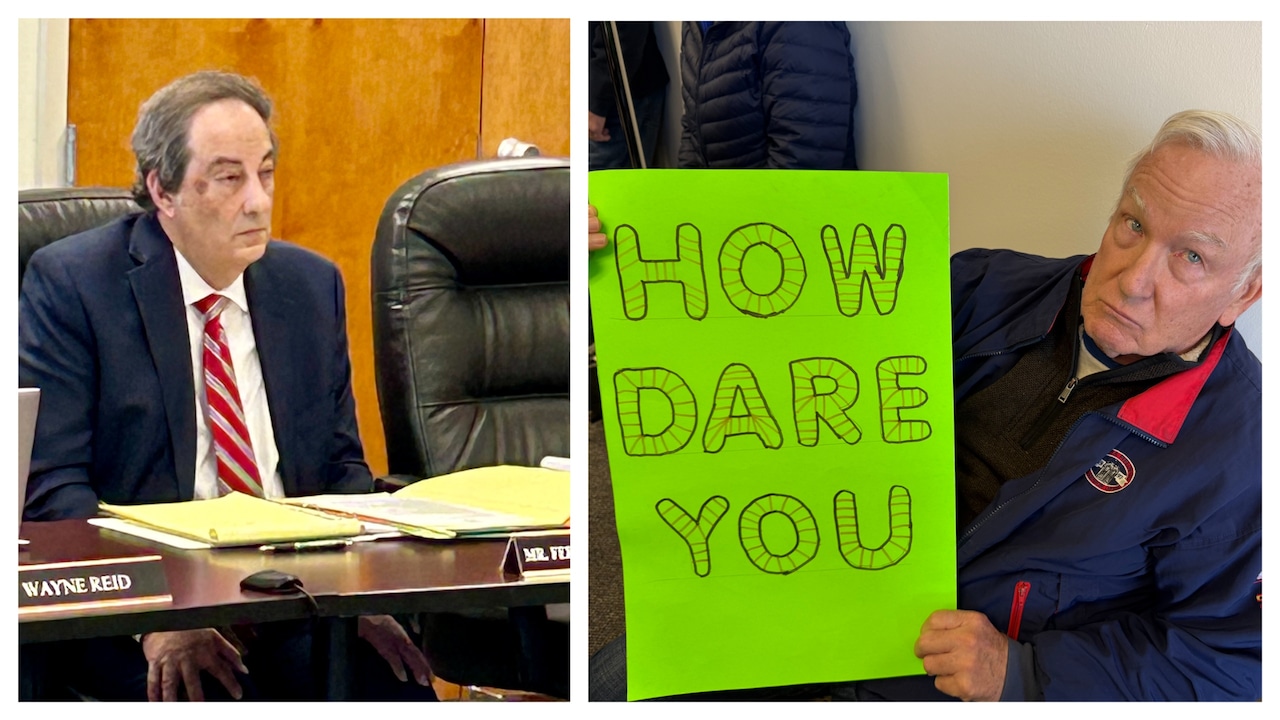
“I would just ask that we do have a chance to actually meet them before …” Stephens began, but the crowd’s jeering drowned out the rest of his hypocrisy.
I asked Stephens after the meeting about his contradictory arguments. How he could stifle Conroy’s concerns while using the exact same arguments to justify his own.
“There’s no contradiction. There’s no contradiction,” he said, as if repeating it would make it true. “I just assumed everybody knew him (Brewbaker).
None of those items were on the agenda, and neither was one that brought cheering to the crowded meeting room. It would formally allow public comments at future meetings.
Stephens and Barnett voted against, saying listening to the public took too much time, it wasn’t the people’s place, and commissioners shouldn’t have to listen to the same arguments over and over.
But it passed, and now the board that runs Alabama Public Television has to listen and watch things they disagree with. Which is sort of a victory.
I asked Johnny Curry, a longtime GOP lawmaker and former head of the Jefferson County Republican Party who sits on the Alabama Educational Television Foundation Authority, if there were rules to this place at all.
“The rules are like sandlot baseball,” he said.
Stephens and his allies in these meetings seem to rationalize most of their decisions by citing the “Alabama values” Gov. Kay Ivey mentioned in a letter she wrote last year when the controversy began.
“I have worked hard to promote and defend Alabama values – from standing up for the sanctity of human life and our rights to religious liberty and standing against DEI, CRT, and boys playing girls’ sports” the governor wrote in the second paragraph of that letter. “For the sake of our people, it is imperative that APT’s programming align with Alabama values.”
What they don’t talk is the first paragraph, when the governor clearly says a disaffiliation from PBS “should be undertaken only after a thorough planning process and only with a thorough understanding of public opinion.”
Or the paragraphs that come later.
“The Commission should thoroughly survey Alabama voters to ensure their voices are heard,” insisting that a survey of voters be done by a reputable firm and be conducted over a sustained period of time.
“If the commission is going to disaffiliate from PBS, it should do so in response to trends in voter opinion, not just an isolated snapshot,” she wrote.
The rules on this board really are like sandlot baseball. If you’re playing to lose.