


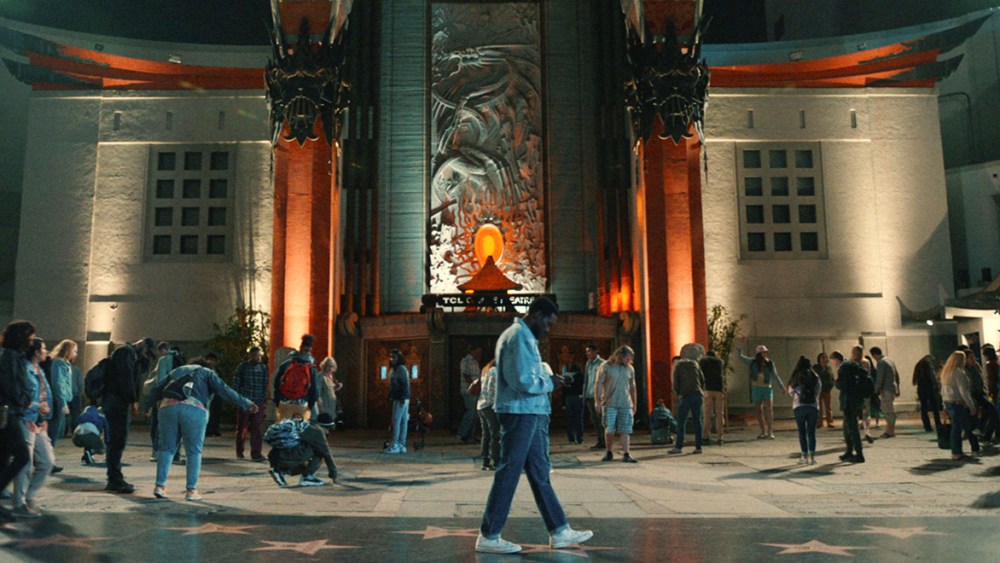
Marvel Television’s new limited series “Wonder Man” is a meta look at superhero stardom, with Yahya Abdul-Mateen II taking on the role of Simon Williams, the aspiring actor with supernatural powers. As a Hollywood hopeful, Simon makes the rounds of familiar L.A. studios, restaurants and movie theaters, hoping to be cast in the reboot of the superhero movie “Wonder Man.” From the iconic movie palaces of Hollywood Boulevard to the streets of Pacoima, “Wonder Man” is full of authentic L.A. flavor.
It helps that production designers Cindy Chao and Michele Yu are both Los Angeles natives with years of memories of seeing movies at local theaters and enjoying quirky sights like the giant Superior Tile man looming over Laurel Canyon Boulevard in the Valley, which makes an appearance in the show.
“Production design, when it comes to location shooting, is very much the curation of the world around us,” says Yu. “So we were very intentional in helping locations and our directors find establishing shots like this, because we wanted to show things that were less obvious and more evocative.”
“We wanted to show a version of L.A. that digs beneath all of the layers. We came into the show thinking about peeling back the layers of the onion,” she continues. “The reality of Hollywood as a physical experience doesn’t necessarily hold up to that dream, right? But it was important for us to be able to show that, and shoot at all of these locations that ran the gamut of what you expect, what you dream about — what you really live if you’re living in L.A.”
Yu and Chao took the crew on field trips to experience all facets of the city, including several that didn’t make it into the show, such as Randyland, a folk art-esque display of colored bottles in Echo Park.
The production designers detailed the thinking behind some of the show’s locations and how important it was to them to be able to shoot in Los Angeles.
The Highland and Eagle Theaters
Simon and Trevor meet for the first time at a screening of “Midnight Cowboy” at the Highland Theater in Northeast L.A.’s Highland Park neighborhood. It’s one of at least six classic L.A. theaters shown in the series.
“It was scripted that we were in and out of movie theaters every other episode, and we really felt strongly that it was important to show a variety,” says Yu. “We wanted a locally known, visually interesting theater.”
Later on, Simon flashes back to going to the movies in the ’90s with his father, so the Eagle Theater in Eagle Rock, now Vidiots, was dressed to be accurate to the period. The designers also made sure there was a fruit vendor outside to give the neighborhood authenticity.
The film location at Lloyd Wright’s Sowden House:
Designed by Frank Lloyd Wright’s son Lloyd Wright in 1926, the visually distinctive Sowden House in Los Feliz has appeared in films from “L.A. Confidential” to “The Aviator.”
The house is where a crew is shooting the movie-within-a-movie in “Wonder Man.” “It’s architecturally significant, designed by Lloyd Wright, uniquely L.A. to its roots. It’s Neo-Mayan architecture, and it looks like a ziggurat, so it’s instantly ominous. It’s full of mystique,” says Yu.
The Fox Village Theater
Now owned by a consortium of filmmakers led by Jason Reitman, the Fox Village Theater in Westwood Village is the location of the premiere of the “Wonder Man” movie. The Bruin Theater can also be seen across the street.
“It’s really crazy how many places we shot have closed,” Yu laments. “We want to show that this place was important to people when it existed. For our big Hollywood premiere and Simon’s big moment, we wanted the scene to happen at a place where premieres really do happen. It’s also such a beautiful space with really great flow.”
“The Fox Theater is where I watched ‘Titanic’ with my best friend — watching ‘Titanic’ at that theater was epic,” adds Chao.
Von Kovak’s mansion
Van Kovak is the eccentric filmmaker who is directing the “Wonder Man” remake and lives in a Beverly Hills mansion with a to-die-for view of the city. Trevor and Simon find themselves at the mansion after they go to Break Room 86, the Koreatown nightclub accessed through a nondescript storeroom.
“We wanted a grand gate for where they enter. We looked at places like Greystone, but we wanted something not so recognizable,” says Yu. “The location we did land at, it was such a grand scale and it was such a potential for absurdity just because of some of the architectural touches that were in there.”
“It showcased some of the quirkiness of L.A. and Hollywood that you could get away with once you’re successful,” says Chao.
The Talmadge apartment building
The production designers thought of Ben Kingsley’s character as a faded star who was able to move into the historic Talmadge building on Wilshire Boulevard in Koreatown back when he had more cash. In the years since, he’s added layer upon layer of memories to bring it into its current cluttered state.
“We really liked the evolution of the place, that it is a lot more careworn now, but you can still see the beauty there and the original architecture and Renaissance Revival intricate detailing,” Yu says. “When we start the show, you still don’t really know that much about that character and who he is as a person. You know what roles he’s played in the MCU, you saw him in ‘Shang-Chi.’ We were thinking, he maybe had some early success in his career. He’s clearly been a world traveler, so now it’s a collection of every important memento he’s ever had throughout his life. It’s stuff from all over the world, things that have a story behind them.”
Restaurants: Mother Wolf and Taix
Among the restaurants that Simon visits are Hollywood hotspot Mother Wolf and Echo Park classic Taix French Restaurant.
In choosing the trendy Italian restaurant Mother Wolf, Yu says, “We liked that it was a place that has had its moment as somewhere people paying attention to restaurant openings might clamor to get into – tapping into yet another subculture in L.A. But again, it also has some wildly different history to it – the building used to be a newspaper office.” The designers called the glamorous space a “classic L.A. reinvention.”
“We loved the soft, rich colors and textures of the interiors, and found a lot to play with in creating our set for a pivotal moment in these characters’ careers where we see them asserting their belonging in a place, and with a group, they might previously have felt excluded from. This is their moment of reveling for the first time in their success, and the promised luxury of it,” says Yu.
For Taix French Restaurant, Yu and Chao chose it partly because of their own connections to the historic spot, which recently announced it will close its doors on March 29. “We very much wanted to show as many sides of Los Angeles as we could, and Taix is the kind of local time capsule with big history that was important for us to show. It also felt good to record the place for posterity. The lively classic noisy bar in contrast to the quieter dining sections with comfortable booths all provided the perfect historic L.A. backdrop for intimate, and sometimes tense, moments.”
Radford Studios/Paramount studios
The movie studio in “Wonder Man” is a combination of the Radford Studios and its New York street and the Paramount lot. “When I think of old Hollywood, I immediately think of Paramount for some reason,” says Chao.
“We wanted the characters to have a big magical Hollywood studio experience,” adds Yu.
Shooting in Los Angeles was important to the designers not just for the proximity and personal connections, also for the health of the business.
“There’s just no place like L.A.,” says Yu, “I think if there is a way for this industry to come back to Los Angeles, only good things can happen. In terms of crew, in terms of vendors, in terms of weather, in terms of shootability and just history — it’s a place that unfolds to you when you figure out who you are and you find your place in the city. And it’s the city that rewards you for doing that work.”