


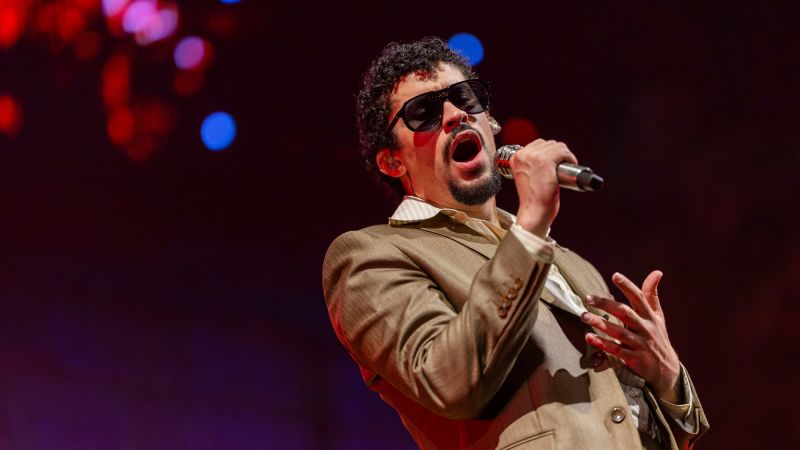
Bad Bunny sings in Spanish. Almost always. But it’s not a simple decision – it’s a statement. In an industry that has historically pushed Latin artists to translate themselves, soften their edges, or neutralize their identity to become global stars, Benito Antonio Martínez Ocasio chose the opposite. Bad Bunny, as he is known, doesn’t explain Puerto Rico in his songs; instead, his songs simply are Puerto Rican. And in that choice, there is politics – even when the song seems to speak only of love, partying, or heartbreak.
This stance became even more visible when he decided not to host concerts in the continental United States during his 2025-2026 world tour, worried that ICE would put his fans at risk. However, he still agreed to headline the Super Bowl, taking place this Sunday at Levi’s Stadium in Santa Clara, California.
Bad Bunny singing at the Super Bowl means bringing Spanish-language songs, fully charged with references to Latino culture, to the biggest stage of American TV. To understand why Bad Bunny’s performance generates such enthusiasm and backlash, it’s important to first understand what his lyrics say.
Analysts consulted by CNN said that the decision to perform at the sporting event was calculated: it is a way of asserting the presence of the country’s 65 million Latinos at a critical moment for the immigrant community.
The decision was celebrated by his followers, but it also raised criticism from conservative sectors, especially MAGA supporters, who questioned the singer’s language and his stance on the immigration measures taken by the Trump administration against the Latin community.
The Puerto Rican singer defied critics: “If you didn’t understand what I just said, you have four months to learn Spanish,” he said during his monologue at Saturday Night Live.
But how to understand Bad Bunny’s lyrics? Here’s a guide to not only comprehend his lyrics, but also where they come from and what he is talking about when he sings.
Puerto Rico as a starting point
The politics in Bad Bunny’s songs don’t show up just when he directly mentions the government, gentrification, or the history of Puerto Rico. It comes before: in singing from Puerto Rico to Puerto Rico, using his language and his Caribbean rhythm without adapting them to external consumption.
That is seen in the local slang that he sprinkles throughout his lyrics: words like “Boquete” (one of the songs from his most successful – and most political – album “DeBÍ TiRaR MáS FOToS”), which in Puerto Rico means “pothole in the street” and is used by the singer as a metaphor for a past love.
In “CAFé CON RON” (Coffee with Rum, in English), a collaboration with the Puerto Rican group Los Pleneros de La Cresta, you can hear typical slang such as “loquera,” (party craziness), or “beber un galón,” (drink excessively).
Puerto Rico is not just the backdrop for Bad Bunny’s songs. It is a territory marked by economic hardship, political corruption, immigration, social disparity, and an ambiguous – and uneven – relationship with the United States. All of that is displayed in his lyrics.
In “LA MuDANZA,” Bad Bunny sings, “This is Puerto Rico, people were killed here for raising the flag,” a reference to the 1948 Gag Law, which criminalized the possession or display of the national flag – even inside one’s own home – turning it into grounds for persecution after Puerto Rico had already become a US territory.
In the chorus of “LO QUE LE PASÓ A HAWAii,” Bad Bunny sings: “They want to take my river and also the beach. They want my neighborhood and for your kids to leave. No, don’t let go of the flag or forget the lelolai. I don’t want them to do to you what happened to Hawaii.”
The song is widely seen as a protest against the displacement of communities and the privatization of natural resources – issues that younger generations on the island feel are also happening in Puerto Rico.
“The lyrics of that song, which criticize the gentrification of the island, US federal corruption, and local corruption within the Puerto Rican government … many people in Latin America can read those lyrics and think, ‘Oh, this song reflects my reality living in Mexico or living in Cuba,’” says Albert Laguna, a professor of American Studies at Yale.
Although Debí Tirar Más Fotos – which made history days ago by becoming the first fully Spanish-language album to win the Grammy for Album of the Year – is considered the most overtly political and Puerto Rico-centered album of Bad Bunny’s career, his denunciations and references to the island have been present in his lyrics for much longer.
Leaving, staying, and belonging
That voice reflects part of the experience of those who were forced to leave their home but keep their identity and memories of life on the island alive.
Bad Bunny delves deeper into this nostalgia in “Debí Tirar Más Fotos,” celebrating sunsets and everyday life in San Juan that many miss. “Another beautiful sunset I see in San Juan. Enjoying all those things that those who leave miss,” the artist sings.
But why do they leave? This line from “LO QUE LE PASÓ A HAWAii” sums it up: “He didn’t want to go to Orlando, but corruption pushed him out.” Corruption, lack of opportunity, gentrification, and the displacement of communities have forced thousands of young Puerto Ricans to leave their island behind.
Yet staying – and taking pride in one’s roots – also becomes an act of resistance for Bad Bunny. “No one is getting me out of here, I’m not moving from here. Tell them this is my home, where my grandfather was born,” he sings in “LA MuDANZA.”