


uoY“ ehT“ I“ ot emit kniht yeht eht eht eht eht dneps ”,erawtfos dias yllaer yllaer noitcudorp .tsacdop eceip elpoep ro no fo fo fo deen ”.cisum gnikam ytirojam ytirojam tnemurtsni doog doog teg yojne t’nod ta ta na a ”CV ytnewT namluhS etuniM
ot“ ,ylraelC“ ”,sdrow hsiw ,elohw saw dlot esoht eht eht eht taht sekat dias snoititeper ecudorp yalp tcefrep fo fo fo ,ylsuoivbo ton .cisum cisum cisum cisum tsom setunim gnikam tol si eh dah ”.nuf rof yreve elbayojne tnereffid yad ,txetnoc stib era dna .gnizama lla ,dedda a ehT namluhS nO I I I .PA
Udio CEO pitches his company as the friendly alternative
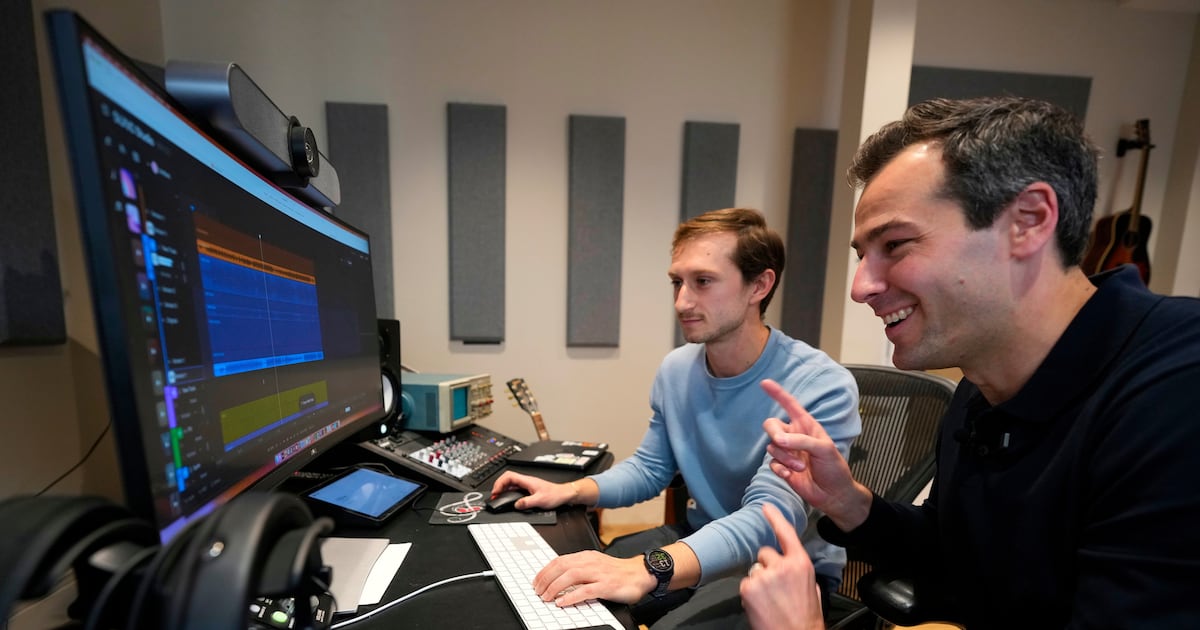
Sanchez, the Udio CEO, also would like people to know he loves making music. He’s an opera-loving tenor who’s sung in choirs and grew up crooning Luciano Pavarotti in his family’s home in Buffalo, New York.
Founded in 2023 by a group that included several AI researchers from Google, the startup now employs about 25 people. It has fewer users and raised less capital than Suno, reducing its leverage in its negotiations with record labels.
But like ride-hailing company Lyft, which pitched itself as the friendly alternative to Uber’s aggressive expansion tactics more than a decade ago, Udio embraces its underdog status.
“So many tech companies actively cultivate this I-am-a-tech-company-crusader and that’s part of their identity,” Sanchez said. “That alienates people who are creative and I am uniformly opposed to that.”
Sanchez said he knows not every artist is going to embrace AI, but he hopes those who leave the room after talking with him realize he’s not imposing a kind of “AI bravado.”
“If you took what we’re doing and pretended that the word AI wasn’t a part of it, people would be like, ‘Oh my gosh. This is so cool.’”
Some see potential in AI-assisted music creation
In the basement office of his Philadelphia, Mississippi home, Christopher “Topher” Townsend is a one-man band, making and marketing Billboard-chart-topping gospel music — none of which he sings himself — and doing it in record time.
The rapper, whose lyrics reflect his political conservatism, downloaded Suno in October and, within days, created Solomon Ray, a fictional singer that Townsend calls an extension of himself.
Townsend uses ChatGPT to write lyrics, Suno to generate songs and other AI tools to create cover art and promotional videos under the Solomon Ray name.
“I can see why artists would be afraid,” Townsend said. ”(Solomon Ray) has an immaculate voice. He doesn’t get sick. You know, he doesn’t have to take leave, he doesn’t get injured and he can work faster than I can work.”
Trying to dispel that fear for aspiring artists is Jonathan Wyner, a professor of music production and engineering at the Berklee College of Music in Boston, who sees generative AI as just another tool.
“To the creative musician, AI represents both enormous potential benefits in terms of streamlining things and frankly making kinds of music-making possible that weren’t possible before, and making it more accessible to people who want to make music,” he said.
Such a vision remains a tough sell for artists who feel their work has already been exploited. Merritt says she’s particularly concerned about labels making deals with AI companies that leave out independent artists.
Neither Sanchez nor Shuman was invited to the Grammy Awards in February, but both spent time schmoozing at the sidelines of the event.
“I think AI music is still officially not allowed, and my hope is that some of these rules change over the next year, and then maybe the 2027 Grammys, I’ll get an invite,” Shuman said.
—————-
O’Brien reported from Cambridge, Massachusetts and New York. Ngowi reported from Cambridge and Somerville, Massachusetts. AP journalists Sophie Bates in Philadelphia, Mississippi and Allen G. Breed in Raleigh, North Carolina, contributed to this report.