


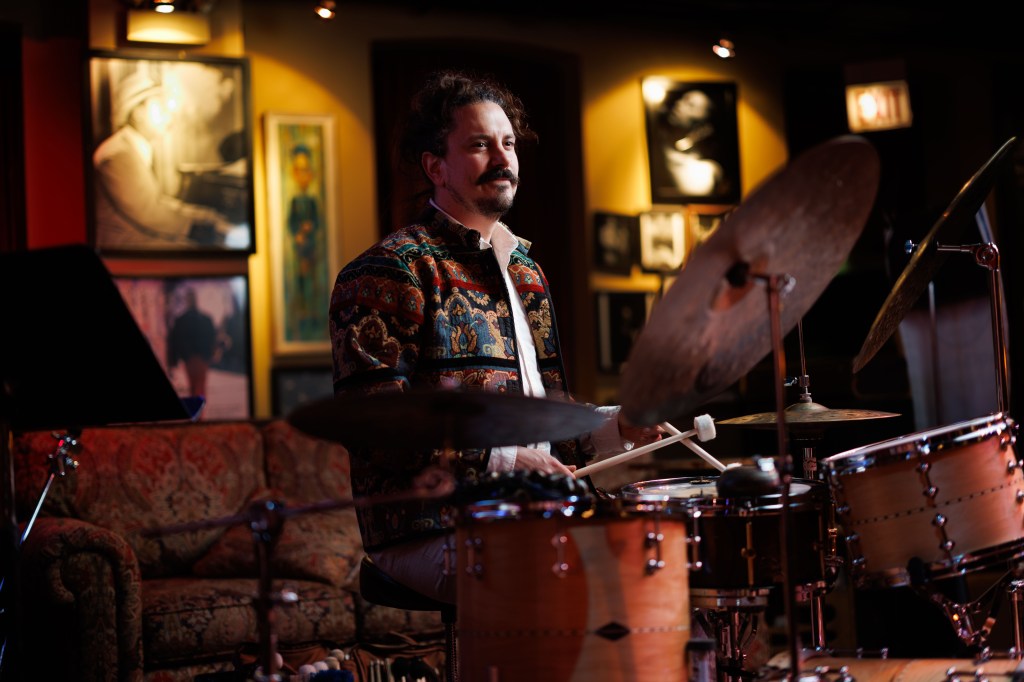
Gustavo Cortiñas doesn’t “do” absolute music — music for music’s sake. The Humboldt Park-based drummer’s work is always about something.
2022’s “Kind Regards/Saludos Afectuosos” collaged immigrant narratives from both sides of the U.S.-Mexico border. Before that, Cortiñas’s bookworm tendencies inspired “Desafío Candente” (2021), on the work of Uruguayan writer and theorist Eduardo Galeano, and “Esse” (2017), which referenced philosophers and their works.
“I’m thinking about it all the time, trying to make sense of the world in some way,” he says of those texts.
Not too many jazz drummers would casually reference Plato’s allegory of the cave in a chat. But Cortiñas, 38, isn’t most jazz drummers. His latest album, “The Crisis Knows No Borders,” took on as potent and enormous a topic as climate change. In the bilingual “Kind Regards,” Cortiñas proved as gifted a lyricist as a composer; “Crisis” returned to pure instrumental heat, written for a fiery and unconventional quartet of drums, saxophone, violin and guitar.
Released in April, the album earned a well-deserved nod on Downbeat’s year-end best-albums list. Earlier this year, Cortiñas also received a prestigious Sistema Nacional de Creadores de Arte grant, essentially Mexico’s answer to the National Endowment for the Arts.
But Cortiñas isn’t one to rest on those laurels. As he told me earlier this month over jibaritos (his favorite spot is Cafeteria Marcela’s in Logan Square), his 2026 and 2027 are already crammed with projects, thanks to the SNCA grant. In June, he’ll release the musically provocative “The Drum Also Sings,” interpreting 10 originals — complete with melodies and harmonies — for drums alone. Fellow percussionists Dave King and Isaiah Spencer assist on that album; among the featured guest vocalists is Angel Bat Dawid, the Tribune’s 2021 Chicagoan of the Year in jazz.
Further out, he’s planning a follow-up to “Kind Regards,” either to be called “Kindness Is Off-Brand” or “Secret Thoughts,” after one of the songs on the album. (“No one will ever be able to know the lyrics, because it’s everything that I wish I could say that I can’t in these times,” Cortiñas says.) Also cooking is “Rostros Migratorios,” or “Immigrant Faces,” a multimedia “documentary suite” weaving interviews and music.
Cortiñas himself is an immigrant to the U.S., growing up in Mexico City. His father was a law scholar and his mother a teacher; postcolonial literature was common dinner-table chatter in his household. Cortiñas learned English, then drums, from the Beatles, playing the backbeat to “Lucy in the Sky with Diamonds” during his first drum lesson. An accidental drum lesson, Cortiñas adds: His older brother was a no-show at one of his lessons. Not wanting to waste the fee, Cortiñas’ father threw him in instead.
After formative encounters with touring jazz artists in Mexico, Cortiñas arrived in the U.S. as an international student in 2007, studying at Loyola University in New Orleans. Living in the city post-Hurricane Katrina may have first planted the seed that grew into “The Crisis Knows No Borders.” But at the time, he just wanted to cut his teeth in a jazz capital.
It “kicked my ass,” he recalls, “and it was freaking beautiful.”
Cortiñas attended Northwestern University for further studies with then-jazz studies director Victor Goines, who also appeared on “Snapshot” (2013), his first album as a bandleader. The first Chicago show he ever attended was a Jazz Showcase appearance by Chuchito Valdés, a pianist in the mold of his legendary father, Chucho.
Now, not only has Cortiñas played with Valdés, but he leads his own bands at the storied venue regularly. “My wife and I, we have a joke that it’s like my church,” he says of the Showcase. “If I ever have a Sunday off, I want to go.”
It’s also one of a few venues where Cortiñas can take his new best friend: his 5-month-old daughter Violeta, so named because the resilient and adaptable flower “grows everywhere.” Just like her father’s music.