


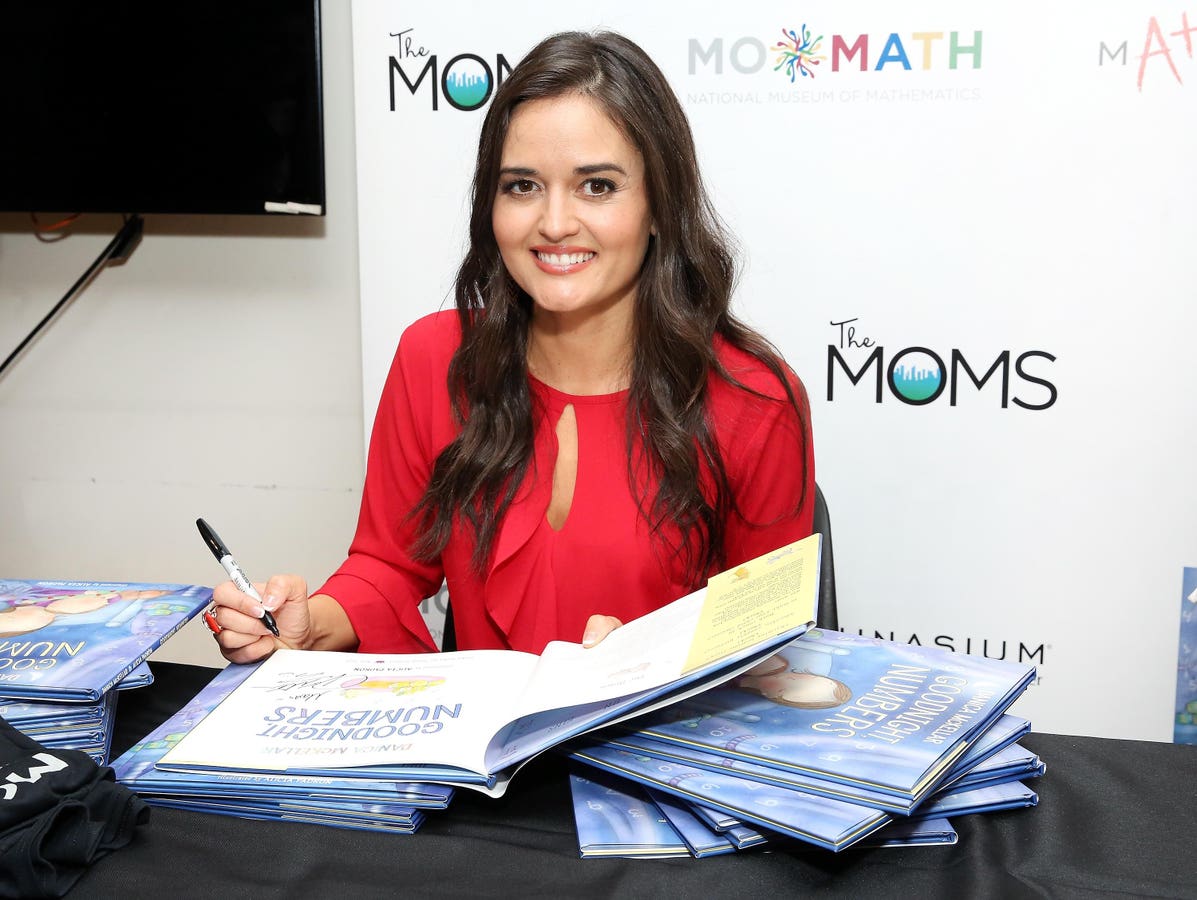
Danica McKellar was a familiar presence on television screens this holiday season. Although she first won viewers over as Winnie Cooper in The Wonder Years, McKellar is best known for starring in 12 Christmas movies that see regular rotation this time of year.
McKellar also has the role of mathematician in the real world. She not only graduated with a degree in math from UCLA but also co-authored a theorem. For nearly two decades, McKellar has applied her passion for math and her love of storytelling to make the subject easy and fun to learn.
“I love taking something intimidating and making it understandable and fun,” McKellar told me just before the holiday season during a Zoom call to celebrate her twelfth math book for kids, I Love You 100.
The lessons McKellar’s learned as a professional storyteller apply to leaders and business professionals who need to make their communication simple, clear, and actionable.
Meet the audience where they are
McKellar is a mathematician who doesn’t write for mathematicians. In the same way, you might be an expert in your subject, but if you’re explaining complex ideas to non-experts, you must think about your audience first.
McKellar knows her audience (young readers) and what scares them. In high school, math scared her, too. So instead of opening her books with numbers, formulas, and definitions, she meets the audience where they are.
For example, in Math Doesn’t Suck, the bestseller that launched McKellar’s math series, she opens with a simple question you wouldn’t expect to find in a textbook: Have you ever made a friendship bracelet?
She then explains how a bracelet of 24 beads—16 onyx and 8 jade—can be grouped in different ways. And with this simple example that nearly all her young readers could relate to, McKellar begins to explain prime numbers and factors.
Math Doesn’t Suck is aimed at a specific audience: middle-school students who are reaching an age when math anxiety spikes. McKellar’s skill is meeting these readers exactly where they are, at a time in their lives when they’re looking for fun and friendship.
In business, communicators often lose their audience because they start the discussion too far ahead or too deep into the weeds. Don’t assume a level of knowledge or interest that the audience hasn’t yet built.
Whenever I speak to professional audiences, I ask a very long list of questions as part of my research, well before I build the slides. Questions that relate to the average age of the audience, demographics, experiences, goals, and the challenges they face.
The more you know about your audience, the easier it’ll be to find familiar reference points to draw them in.
Translate complexity into plain language
McKellar has mastered an extremely difficult skill—simplifying complicated mathematical concepts and adjusting those explanations for specific age groups from preschool to high school.
“Math is a language,” McKellar told me. “If it remains foreign, it’s intimidating and scary. So we have to translate math into something that makes sense for kids.”
For example, in Kiss My Math, a book on pre-algebra for 7th- to 9th-grade girls, the first chapter is on integers. “I’m sorry, but integer has got to be the most boring word I’ve heard,” McKellar writes. “Well, I propose something different. We’re not going to talk about these so-called integers, or I might fall asleep while typing. Instead, the chapters of this book are filled with things like breath mints, pandas, popularity, gift wrapping, and spas.”
Writing in plain language doesn’t mean “dumbing down” the idea. It means removing unnecessary friction, such as impenetrable jargon or long, convoluted sentences. It means using words your audience uses in natural conversations, and not when they’re trying to impress others.
McKellar’s focus on “translating” language reminds me of KPMG’s chief economist Diane Swonk, a popular and sought-after guest for business reporters. Before she puts out a report for clients or sits down for a television interview, she thinks about unique analogies, comparisons, and simple language to make things easier to grasp.
“I look for any kind of hook that makes economics more understandable,” Swonk says. “I think of my job as a translator.”
You owe it to your audience to share ideas simply. “If you have a point to make, you can make it clear,” McKellar says.
Lead with visuals, not text
McKellar works in television, a visual medium, and she brings that same sensibility to her books. Abstract concepts traditionally presented as text and formulas are reimagined as concrete visuals and spatial metaphors.
In The Times Machine, a book about multiplication and division, McKellar uses cartoon-style visuals of ancient Roman structures to explain the difference between rows and columns. Columns are the tall stone pillars found in Roman architecture, and when a dot is placed within each column, it becomes a row.
Since the human brain processes images faster than words, we intuitively understand spatial relationships. When you see a bubble chart, for example, comparing the size of categories to one another, that’s spatial visualization. That’s why social media and the business press is filled with infographics, animations, and visualizations. Visuals are more interesting than text alone.
McKellar asks a simple question that applies to anyone who wants to elevate their communication skills: “Do you want to seem smart or actually reach people?”
Anyone can show off their expertise. But truly reaching people requires deliberate storytelling and a sharp focus on the audience: who they are, what they know, and what they need to know.