


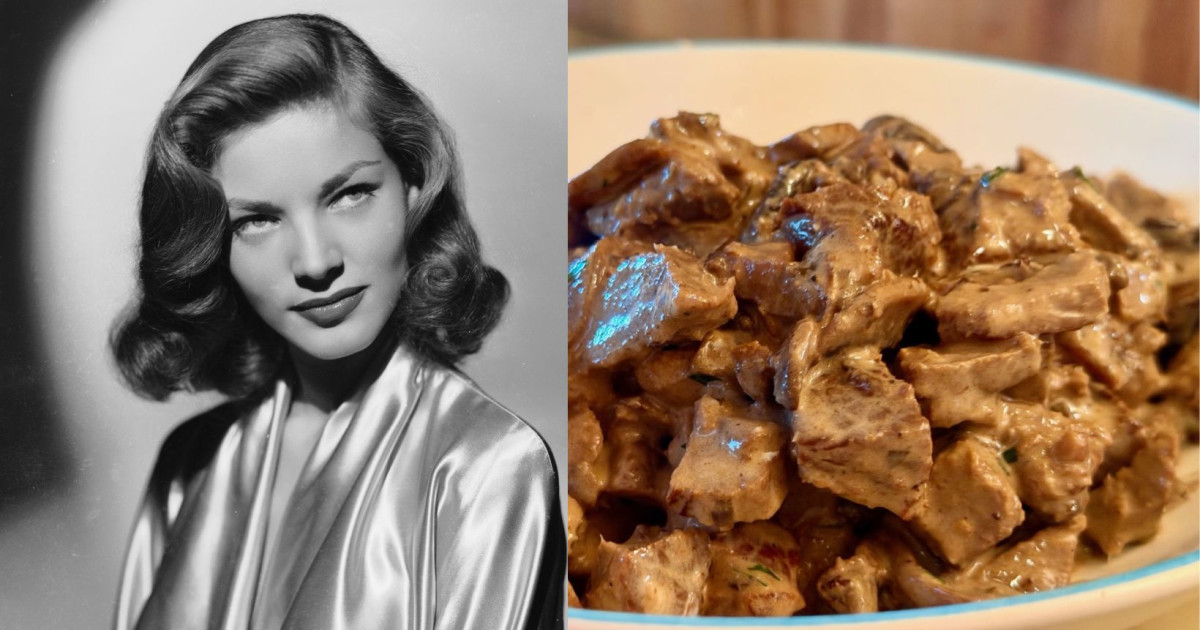
There was a kind of vintage glamour only Lauren Bacall could conjure: smoky, sharp-witted, and quietly commanding. She projected intelligence as seductively as other stars wielded softness, and she never seemed to apologize for knowing exactly who she was.
Bacall was the sort of woman who understood her own appetites—she liked her martinis dry, her conversations brisk and her men capable of keeping up—and she saw no need to explain or soften those preferences. That same self-possessed confidence is what first drew me to her Beef Stroganoff recipe, a dish as unfussy and assured as the actress herself. It promises satisfaction without spectacle, comfort without indulgence, elegance without excess.
The recipe appears in What Cooks in Hollywood, a 1949 celebrity cookbook that reads less like a novelty collection and more like a social register of postwar stardom. Bacall attributes the dish to Carl Combs, a formidable Warner Bros. publicist and close friend, a detail that lends the recipe some extra credibility.
This wasn’t merely a celebrity recipe offered for novelty’s sake; it was a glimpse into the functional glamour of Bacall’s world, where good taste had to coexist with long studio days, late dinners, and little patience for unnecessary frills. In that context, the stroganoff feels less like a relic and more like a working woman’s solution: reliable, polished and quietly confident—much like Bacall herself.
I was excited to try this vintage recipe in my kitchen to see if it would still hold up, or whether it was simply a souvenir of Hollywood’s post-war moment. My cooking adventure had a few twists, turns and surprises, but I ended up with a pretty good story—and a tasty meal. Read on for all the juicy details and the info you need to make this dish at home.
Related: Sophia Loren’s Simple Spaghetti Sauce Is a Weeknight Winner
😋😋 SIGN UP to get delicious recipes, handy kitchen hacks & more in our daily Parade Eats newsletter. 🍳🍔
What Is Beef Stroganoff?
Today, beef stroganoff is one of the ultimate comfort foods: creamy, familiar and reliably weeknight-friendly. However, its origins are far more formal. The dish takes its name from the Stroganovs, one of Imperial Russia’s wealthiest families.
The first known version appeared in the 1871 Russian cookbook A Gift to Young Housewives by Elena Ivanovna Molokhovets. That original iteration featured floured beef sautéed and finished with broth, mustard and sour cream. There were no mushrooms and definitely no noodles. By the time it reached 1949 Hollywood, it had evolved into a “Continental” dining staple, symbolizing mid-century sophistication.
Related: Tried 12 Beef Broth Brands To Find the One You Should Stock in Your Pantry
Ingredients Needed To Make Lauren Bacall’s Beef Stroganoff
The ingredient list for Bacall’s Stroganoff is surprisingly minimal:
Beef round steak
Butter
Mushrooms
Sour cream
That’s it!
Related: The Goldie Hawn Comfort Recipe That Daughter Kate Hudson Calls ‘A Classic in Our Family’
How To Make Lauren Bacall’s Beef Stroganoff (My Version)
After reading the recipe, I immediately knew Bacall’s instructions would be tricky for a modern palate. The recipe calls for a pound of round steak and a mountain of mushrooms to be simmered in sour cream for 40 minutes. By today’s culinary standards, that is a recipe for disaster, AKA rubbery beef and a “broken” (curdled) sauce.
In the mid-century era, “tender” was earned through long cook times, and a grainy sauce was simply an accepted texture of dairy pushed by heat. I wanted the glamour of this dish, without the grit, so I made some adjustments.
To bring this 1949 classic into the modern era, I started with the foundation: a pound of beef round steak and mushrooms. While modern recipes often call for tenderloin or rib eye, the round steak offers a deep, beefy flavor that stands up well to the rich, creamy sauce. I hand-cut the beef into 1.5-inch squares, a size just large enough to retain some juiciness as it cooked.
In a heavy skillet, I melted a generous amount of butter until it began to foam, then added the beef. I seared the lightly salted and peppered meat until it had developed a nice, golden crust, then removed it from the pan and set it aside.
This allowed me to add the 8 ounces of sliced mushrooms to the same skillet, letting them brown and release their liquid in the beef drippings without overcrowding the pan.
This is where vintage instructions and modern science began to clash. The original recipe suggests adding the sour cream now and simmering for 40 minutes, but to avoid a curdled mess, I took a different route.
Once the mushrooms were browned, I returned the beef to the skillet and deglazed the pan with about half a cup of beef broth, scraping up all those flavorful brown bits from the bottom of the pan.
I lowered the heat, covered the pan, and let the beef gently braise in the broth for approximately 30 to 35 minutes. This gave the round steak the time it needed to become fork-tender.
Once the beef was perfectly tender and the broth had reduced to a savory glaze, I moved to the final, crucial step. I removed the skillet from the heat entirely to let the temperature drop slightly. I then took a cup of room-temperature sour cream and slowly folded it into the beef and mushrooms.
By stirring in the sour cream off the heat, the sauce transformed into a glossy, velvety coating that clung to the meat beautifully.
To honor Bacall’s “silverware optional” style, I toasted thick slices of crusty sourdough until they were golden-brown and piled the stroganoff high on top. The bread acted as the perfect vessel, soaking up the rich, tangy sauce while providing a necessary crunch that egg noodles simply can’t match.
Related: The Simple Mushroom Trick You Need To Know About, According to Top Chef Judge Tom Colicchio (Exclusive)
Lauren Bacall’s Beef Stroganoff: My Honest Thoughts
What truly sets this stroganoff apart is the plating. Forget the typical plush nest of egg noodles; Bacall’s recipe calls for the beef to be spooned onto crisp crackers or thick, toasted bread.
It’s a dish engineered for efficiency: easy to hold, easy to share and meant to be eaten without pause. You can easily imagine it disappearing between takes in a dressing room or making the rounds during a late-night script reading, where conversation was paramount and silverware was optional.
With only a few tweaks to the process, this dish manages to feel both true to the 1949 original and freshly revitalized for a modern kitchen. Drawing on my own experience with cooking beef, I made those necessary adjustments along the way, and though I strayed from the vintage instructions, the recipe’s foundation proved impressively solid.
The final result was satisfying and flavorful. The beef was tender with plenty of character, and the sauce was silky without feeling heavy. The flavors came together beautifully, a testament to how well-balanced and forgiving this recipe actually is. Serving it on toast feels deliberate and sophisticated. The bread acts as the perfect vessel, soaking up the rich, tangy sauce while providing a necessary crunch.
Bacall’s stroganoff isn’t a gimmick, and neither is this update. It’s a reminder that elegance often lies in restraint and that the most enduring dishes are those pared back to their essence.
While I enjoyed making the recipe my own, I have no doubt that the original version was just as impressive in its heyday. Whether enjoyed in a Russian dining room or a Hollywood dressing room, beef stroganoff has always been about the mastery of flavor and presentation. Perhaps that’s why Bacall’s version still resonates: the most sophisticated way to eat it is not just with a forkful of noodles, but with confidence, composure and the small thrill of doing something classic, perfectly.
Related: I Tried Ina Garten’s Super Simple Meatloaf and It’s an Instant Classic
3 Tips for Updating This Recipe
To respect the spirit of the dish while correcting its vulnerabilities, I made a few pivotal changes:
1. The cut
I kept the round steak but hand-cut it into substantial 1.5-inch squares. This gave the meat enough structure to survive the cook time without disappearing into the sauce.
2. The technique
Instead of simmering the beef with the sour cream, I simmered it in a shallow pool of beef broth. This allowed the connective tissue in the round steak to break down until tender without curdling the dairy.
3. The finish
Only at the very last moment did I fold in the sour cream, whisking it into a glossy, cohesive and stable sauce.