


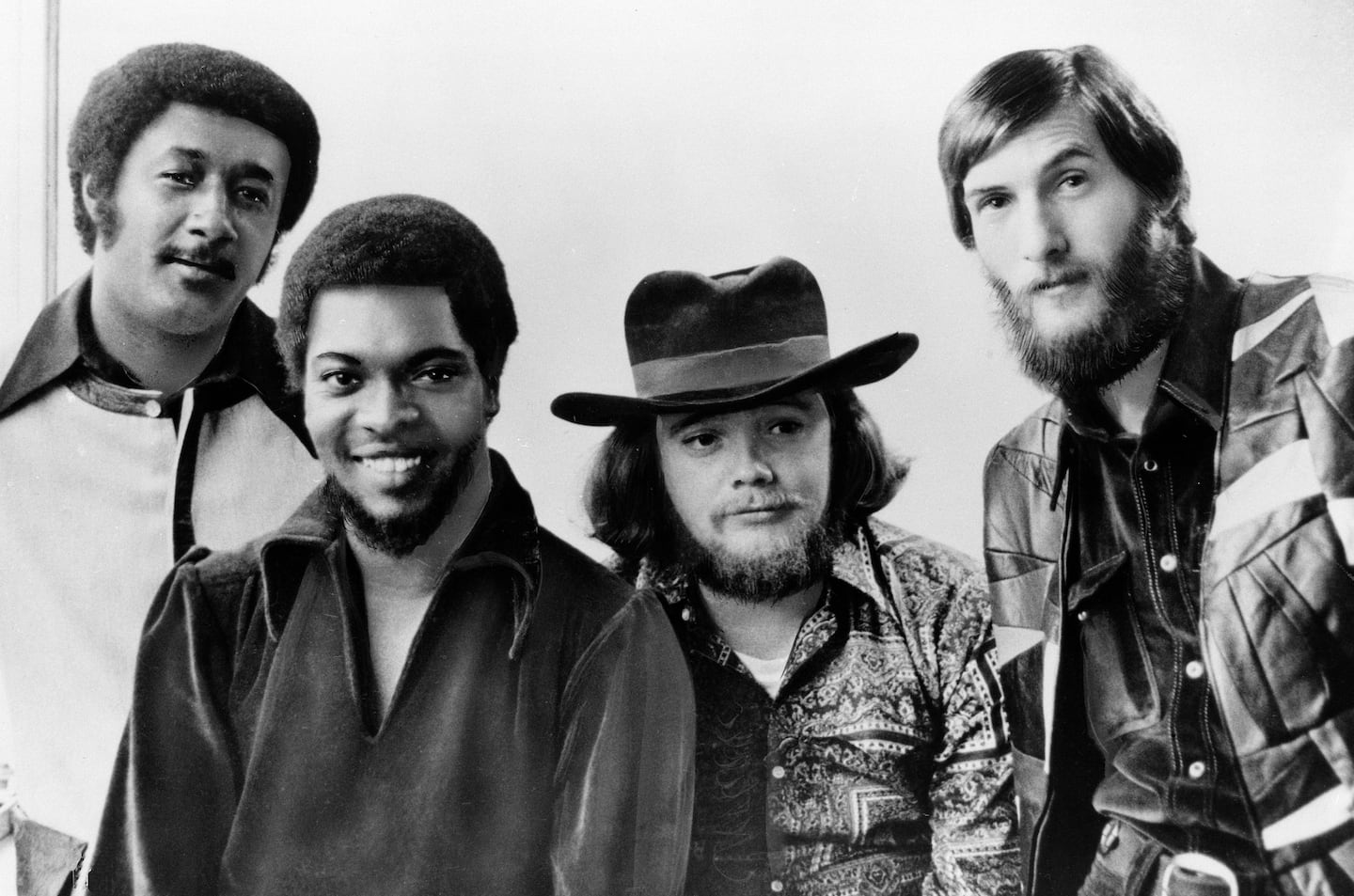
Cropper had an innate feel for a groove as well as a penchant for feeling over flash — gifts evident in his bell-toned guitar work on Otis Redding’s “(Sittin’ on) The Dock of the Bay.” In 2015, he was ranked 39th on Rolling Stone’s list of the 100 greatest guitarists of all time. Britain’s Mojo magazine slotted him second, behind only Jimi Hendrix, on a similar list of guitarists published in 1996.
“I’ve always thought of myself as a rhythm player,” Cropper said in an interview with Guitar.com in 2021. “I get off on the fact that I can play something over and over and over, while other guitar players don’t want to even know about that. They won’t even play the same riff or the same lick twice.”
Cropper was also a prolific songwriter. His credits, typically as a co-writer, include the epoch-defining likes of “Dock of the Bay,” Wilson Pickett’s “In the Midnight Hour” and Eddie Floyd’s “Knock on Wood.” All three were No. 1 R&B singles. Redding’s record topped the pop chart as well, and won Grammy Awards for best R&B song and best male R&B vocal performance in 1969.
In charge of artists and repertoire at Stax during the 1960s, Cropper produced the recordings of many of the songs he had a hand in writing. His website states that he was “involved in virtually every record issued by Stax from the fall of 1961 through year end 1970.” Judging by the testimony of the Stax co-founder Jim Stewart, it is not hard to imagine that this was the case.
“Steve was my right-hand man,” Stewart said of Cropper’s contributions to the label’s legacy in Peter Guralnick’s 1999 book, “Sweet Soul Music: Rhythm and Blues and the Southern Dream of Freedom.” “He would come to the studio and sit there and keep the doors open and take care of business; he was disciplined and responsible. Steve was the key.”
In the process, Cropper helped reimagine the Southern soul music of the era, imbuing it with a simultaneously urban and down-home feel — a bluesy mix of sinew and grit that was instantly recognizable over the radio airwaves. Widely sampled, the records he played on or produced influenced subsequent generations of musicians, especially in hip-hop and R&B.
Cropper achieved further acclaim in the late 1970s for his work with the Blues Brothers, the musical side project of the “Saturday Night Live” co-stars John Belushi and Dan Aykroyd. By then, Stax had closed, having fallen into insolvency in 1975, and Cropper had begun immersing himself in freelance session and production work with artists such as Art Garfunkel and Ringo Starr.
“Briefcase Full of Blues,” the Blues Brothers’ first album, included a remake of “Soul Man,” complete with a reprise of the shout “Play it, Steve!” from Belushi on the chorus. The single reached No. 14 on the pop chart in 1979, anticipating the release of the 1980 movie “The Blues Brothers,” starring Belushi and Aykroyd and featuring Cropper as Steve “the Colonel” Cropper, who plays in a band called Murph and the Magic Tones. (Born of Cropper’s tendency to take charge of situations, the Colonel was a childhood nickname that stuck with him even after he established himself as a musician.)
Steven Lee Cropper was born on Oct. 21, 1941, on a farm near Dora, Missouri, near the Arkansas border. He was the only child of Hollis and Grace (Atkins) Cropper. His father was a special agent for the St. Louis-San Francisco Railway, and his mother was a schoolteacher.
Steve was exposed to country music early, but was introduced to gospel and rhythm and blues only after moving to Memphis with his parents at age 9. He bought his first guitar, by mail order, at 14.
His earliest musical influences were stylistically diverse, among them country guitarist Chet Atkins, jazz guitarist Tal Farlow, bluesman Jimmy Reed, and Lowman Pauling of the influential R&B quintet the “5” Royales. (In 2011, he paid tribute to Pauling’s transfixing fretwork with “Dedicated: A Salute to the 5 Royales,” an album featuring singers like Bettye LaVette and Lucinda Williams performing versions of the group’s recordings.)
As a teenager, Cropper and several schoolmates, including the future MG’s bassist Donald “Duck” Dunn, formed a band called the Royal Spades. After changing their name to the Mar-Keys in 1961, they had a Top 10 pop hit with the slinky instrumental “Last Night.” Cropper had by that point also done session work in Memphis for Sun Records and Hi Records.
In 1962, while Cropper and the MG’s were jamming between sessions at Stax, Stewart, impressed by the riffing, organ-driven blues he heard, surreptitiously captured the quartet’s playing on tape. “Green Onions” was the result.
Booker T. & the MG’s — organist Booker T. Jones served as the ensemble’s leader — served as the rhythm section at Stax for nine years. Its members also included Al Jackson Jr. on drums and Lewie Steinberg on bass. Dunn replaced Steinberg in 1965.
The original MG’s lineup, three-quarters of which was Black (Cropper was white), helped integrate Stax at a time when the four men would not have been permitted to appear on a public bandstand together in the segregated South.
The MG’s had six Top 40 pop hits for Stax, two of which, “Hang ‘Em High” and “Time Is Tight,” were featured on movie soundtracks. Many of their recordings were sampled by hip-hop artists, from Roxanne Shante to Raekwon of the Wu-Tang Clan. According to the website WhoSampled, more than two dozen acts have interpolated into their recordings passages from the MG’s 1971 album, “Melting Pot.”
In 1970, having released two albums of his own (the second was a collaboration with guitarists Pops Staples and Albert King), Cropper left Stax in a dispute over how the label’s new co-owner, Al Bell, was managing things. (“Melting Pot” was recorded before his departure.)
After opening his own studio in Memphis, Cropper moved to Los Angeles in 1975, doing session work for John Lennon and Leon Russell before joining Levon Helm & the RCO All-Stars. From there, he and Dunn were recruited to play in the Blues Brothers, an affiliation that led to multiple tours and recordings, including appearances in a 1998 movie sequel, “Blues Brothers 2000.”
Booker T. & the MG’s were inducted into the Rock & Roll Hall of Fame in 1992. “Cruisin’,” a track from their 1994 reunion album, “That’s the Way It Should Be,” won a Grammy for best pop instrumental performance.
In the 2000s, Cropper released the first of the two albums he made with former Rascals singer Felix Cavaliere and worked on records by the Pixies frontman Frank Black. He was elected to the Songwriters Hall of Fame in 2005. He also appeared in “Stax: Soulsville, U.S.A.,” an acclaimed HBO docuseries in 2024.
Cropper’s first marriage, to Betty Grooms, ended in divorce. In 1988, he married Angel Hightower. In addition to his wife, he is survived by two children from his first marriage, Stephen and Ashley Cropper; and two children from his second marriage, Cameron Cropper and Andrea Cropper-Register.
Cropper’s affiliation with the Blues Brothers spanned four decades. But back in 1978, when he and Dunn first joined the band, skeptics failed to understand why they would want to collaborate with the two comedians from “Saturday Night Live.”
“We got a lot of flak — Duck and I did — about playing with those guys,” Cropper told guitar.com. “Folks said, ‘What are you guys doing with these two clowns from SNL?’”
“But those guys were great musicians,” he went on. “John Belushi had played drums in a band for years before he ever went to Second City,” the Chicago improv comedy troupe. “And Ackroyd is actually playing the harmonica on everything we did.”