


The Sundance Film Festival’s days in Park City are drawing to a close, but its online component, which allows viewers to stream every movie in its competitive sections and a handful of others, is still going strong, at least through midnight on Sunday. The lineup excludes some of the festival’s starry premieres—sorry, you’ll have to head to a theater to see the Charli XCX mockumentary The Moment, out this Friday—but there’s still plenty to sample, even from a relatively weak lineup. The online offerings can still sell out, but movies that win the festival’s jury awards will reappear in TBA slots after the winners are announced on Friday. Even though I’m back from Park City, I’m still streaming like a fiend at home—I’ve heard great stuff about Closure and Filipiñana, among others—but here’s the best of what I’ve seen thus far.
The Best Summer
In 1995, Tamra Davis was coming off the success of Billy Madison and newly married to a Beastie Boy. So when Mike D and the gang headed to Australia to headline a traveling music festival called Summersault, she took her video camera along, capturing a ramshackle tour diary whose footage she rediscovered while fleeing the Palisades wildfire in 2025. With performances by Sonic Youth, Foo Fighters, Pavement, and Bikini Kill, whose Kathleen Hanna does double duty as an onscreen interviewer, the movie offers the tantalizing possibility of being an unofficial sequel to the alt-rock classic 1991: The Year Punk Broke, but Davis was shooting more for fun than to self-consciously capture an era. On an overwhelmingly male-dominated tour, her camera seems pointedly drawn to the few women on stage—as Davis films them, Sonic Youth is a band containing Kim Gordon and a bunch of dudes—and as Hanna quizzes Dave Grohl and Beck about how their stage personas differ from their real selves, you can see her figuring out how to navigate the beginnings of her own mainstream stardom. (You can also, if you watch closely, see her navigating the beginnings of her relationship with the Beasties’ Adam Horovitz—the two have now been together for 30 years.) Davis’ movie is chaotic and rough-hewn, and the performances and songs seem chosen almost at random, but it’s a precious time capsule, and a must for anyone who cares about the bands or the time.
Everybody to Kenmure Street
Felipe Bustos Sierra’s documentary was timely before Sundance began, but the story of a Glasgow community’s successful mass uprising against the unwanted intrusion of immigration agents feels even more so now. The movie, reviewed at greater length here, tracks the way neighbors joined forces throughout the day, and the long history of local political action that laid the groundwork for their apparently spontaneous protest.
Josephine
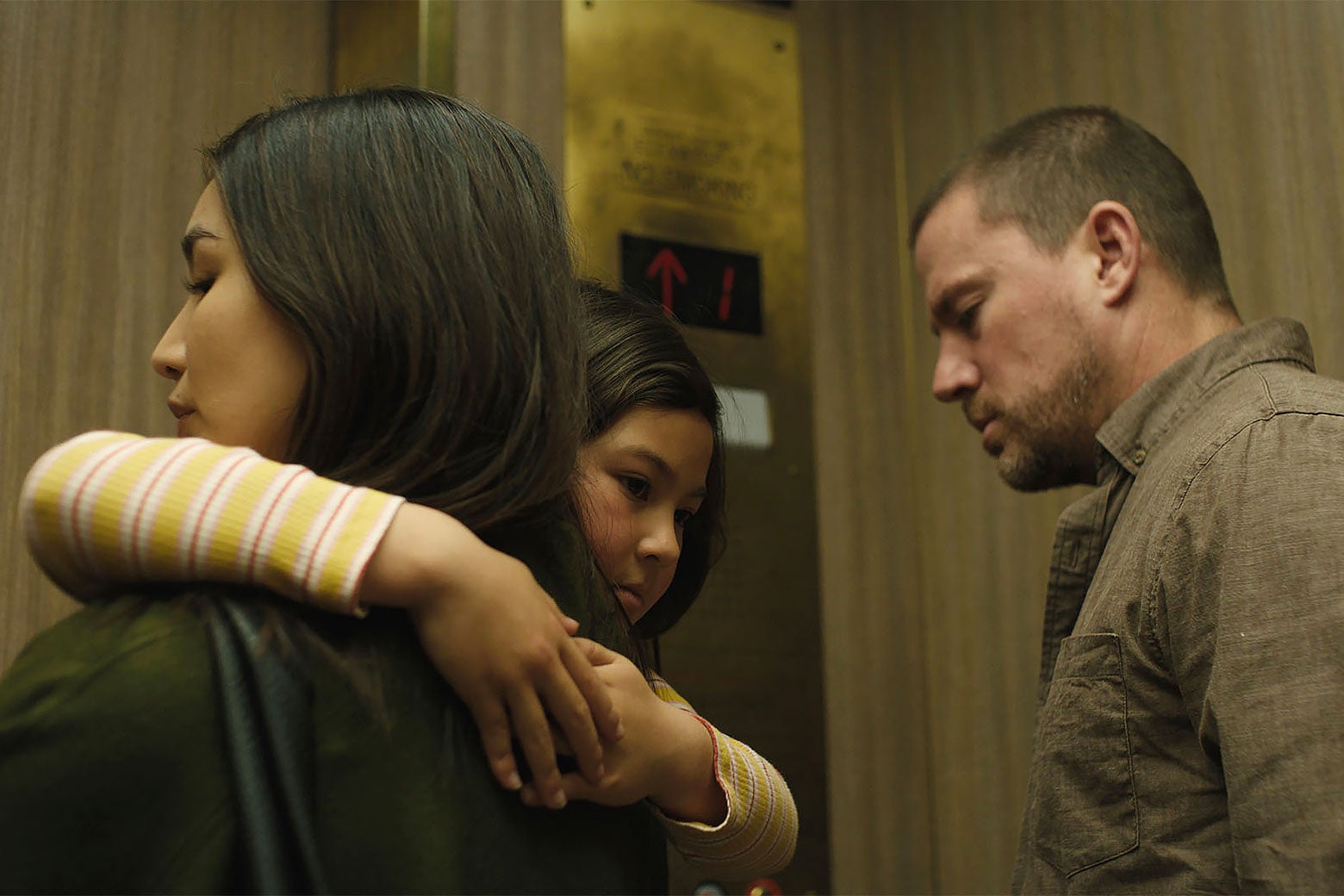
It’s too bad that Sundance’s last year in Park City features one of its weakest dramatic competitions in years, but Beth de Araújo’s movie is a true standout, anchored by a stunning performance by 8-year-old actor Mason Reeves. One day, 8-year-old Josephine and her father (Channing Tatum) are playing in the park when she witnesses a sexual assault. Her father sprints off after the rapist, but the speed with which he leaves behind both his daughter and the victim foreshadows a story in which men’s impulse to punish and protect eclipses women’s need to feel safe and seen. Too young to even understand sex, Josephine isn’t entirely sure what she saw, let alone able to recite it to the array of therapists and lawyers who want to question her, and her mother, played by Gemma Chan, is less concerned with abstractions about justice than the concrete matter of her daughter’s psychological well-being. Tatum plays a loving but emotionally illiterate dad without condescension or apology—you can see that the father is trying his best, even as the movie makes it clear how inadequate that is—and Chan seems to be drawing on a well of pain whose source we can intuit without ever needing to be told. The fact that de Araújo based the story on her own experience shouldn’t be what defines this accomplished and deeply thoughtful film, but it only increases the sense of awe that she so fully and fairly captures all of her characters, not just the one she once was.
The Lake
Activists and the authors of climate fiction often lament how difficult it is to craft narrative urgency around the gradual destruction wrought by climate change; the way we formulate stories is almost perfectly ill-suited to raising the alarm about consequences that may not be obvious until it’s too late. But you would think the possibility that Great Salt Lake might dry up within a decade might be enough to grab people’s attention. Abby Ellis’ documentary shows that it’s still not that simple. The scientists in her movie are practically shouting from the mountaintop about how diverting the lake’s water, mainly to Utah’s agriculture sector, threatens to send it into an irreversible decline. But they’re dismissed and waved aside, even when they warn that the rapid changes in the lake’s ecosystem are generating clouds of toxic dust that could easily make their way to major cities. What makes this more than a standard issue-driven documentary is Ellis’ subtle but insistent tracking of the role religious faith plays on both sides of the debate. Ben Abbott, the Mormon head of the activist organization Grow the Flow, invokes a sense of stewardship over god’s creation, while one farmer counters that “when deity needs to fill that lake, it’ll be filled.” It’s an area that far more movies on the subject could stand to explore, especially in such a diligent and unassuming way.
The Musical
Imagine Election set in a middle-school theater department and you’re much of the way to getting the vibe of Giselle Bonilla’s debut feature, which stars Stereophonic’s Will Brill as a frustrated playwright who channels his anger at the world—not to mention his ex-girlfriend (Gillian Jacobs) and unctuous boss (Rob Lowe)—into a song-and-dance show designed to bring it all crashing down. Alexander Heller’s screenplay is too broad for the comedy to cut as deep as it wants to (although there is one well-placed Wesleyan joke), but Brill’s performance has acid in it as well as bile, a self-lacerating edge that’s just slightly more fascinating than it is repellent.
Night Nurse
Turn off the sound at the beginning of Georgia Bernstein’s erotic thriller and you might think you’re watching an ad for a phone-sex line from the 1980s. But as the camera prowls over a woman’s body spread out on a bed and tangled in a telephone cord, you start to realize that she’s calling for help—and that she doesn’t really need it. A nurse (Cemre Paksoy) comes to a job as the caregiver for an aging man (Bruce McKenzie) in cognitive decline with a mysterious blank space on her résumé, but he’s chased away so many predecessors that his facility doesn’t seem inclined to ask questions—and besides, they have a good feeling about her. The man turns out to be a scammer who coaxes his young women to call up elderly men with memory loss and pose as their granddaughter, who’s been in an accident and needs money now. But the “Please, Grandpa” routine also gives him an erotic charge, and it turns out his new hire shares it as well. Night Nurse has some first-film wobbles that grow more severe as the plot progresses—and, sorry to disappoint fans of The Other Two, Cary Dubek does not make an appearance—but in a genre with too few recent entries and even fewer good ones, it’s a glass of water in the desert.
One in a Million
Decade-spanning observational documentaries have become a rarity thanks to shifting priorities and a parched funding climate, but Itab Azzam and Jack MacInnes’ deeply moving film is practically an advertisement for the unique power of the form. The years between 10 and 20 are fraught ones for any daughter and her parents, but especially so for Isra’a, whose father moves their family from Syria to Germany in 2015. The experimentation of her teenage years and the liberties of a secular Western country combine to take her far from her father Tarek’s Islamic traditionalism, and he lashes out when the better life he fought to secure for his family threatens the only way of being he’s ever known. It’s an aching slow-motion tragedy, told from shifting perspectives that prevent it from collapsing into a glib morality play, and time proves to be the trickiest screenwriter of all. Azzam and MacInnes deftly field their story’s curveballs, and their long-term dedication ensures that even its most surprising turns don’t feel like they come out of nowhere. And though Isra’a and Tarek’s relationship can be painful to witness, the movie’s complicated and unpredictable arc is a poignant reminder that life always has more in store.
Run Amok
“Have fun!” isn’t normally the way a director preps an audience for a movie about the traumatic aftermath of a school shooting, but NB Mager’s debut frames tragedy through comedy, as the daughter of a murdered music teacher (Alyssa Marvin) tries to channel a decade of grief into a high-school jukebox musical. Although Mager shows some flair for satire, particularly around the issue of parents responding to armed threats by mustering an armed threat of their own, the draw here isn’t the movie’s writer-director so much as its star. In a cast that includes Patrick Wilson, Bill Camp, and Elizabeth Marvel, Marvin stands out as a teenager whose messy mourning clashes with the school’s plan to stage a decorous commemoration for the shooting’s 10th anniversary, thwarting attempts to extract a tidy narrative from inexplicable tragedy. Run Amok eventually succumbs to that tendency, but its star makes sure we feel what the movie can’t find words to say.
Time and Water
Like her Oscar-nominated 2022 documentary Fire of Love, Sara Dosa’s new movie combines awe-striking footage of natural wonders with a human story of love and loss. But this time, her protagonist, Icelandic author Andri Snær Magnason, is still around to take part in the process. The movie weaves decades of Magnason’s home movies into the story of his country’s melting glaciers, one of which, Okjökull, was the first to be officially proclaimed dead. Like an ice core whose layers hold bubbles of air from millennia past, Magnason’s narration, adapted from his book On Time and Water, captures the endless battle between permanence and change, and what happens when the things we thought would last forever turn out to be vulnerable to decay. The glaciers can be beautiful even in death—it’s hard to be alarmed by the soothing sound of rushing water—and the inevitable fact of human mortality can feel like a strange fit with the unnatural loss of climate change. But the movie forces us to ponder what remains after we’ve left this earth, and what kind of planet we want to leave behind.
Zi
If you felt stifled by Kogonada’s turn from the melancholy lyricism of Columbus and After Yang to the studio romance of A Big Bold Beautiful Journey, his new movie makes it clear that he felt the same way. Filmed less than three months before its premiere, Zi was made on the streets of Hong Kong with a minimal crew and a cast of three—Michelle Mao, Haley Lu Richardson, and Jin Ha—acting out an elusive story about a trio of wandering souls. Drawing heavily on Agnès Varda’s Cléo From 5 to 7, with a little Chris Marker and Wong Kar-wai thrown in for good measure, it can feel sometimes like a vibe in search of a story, but the vibes are often exquisite.