


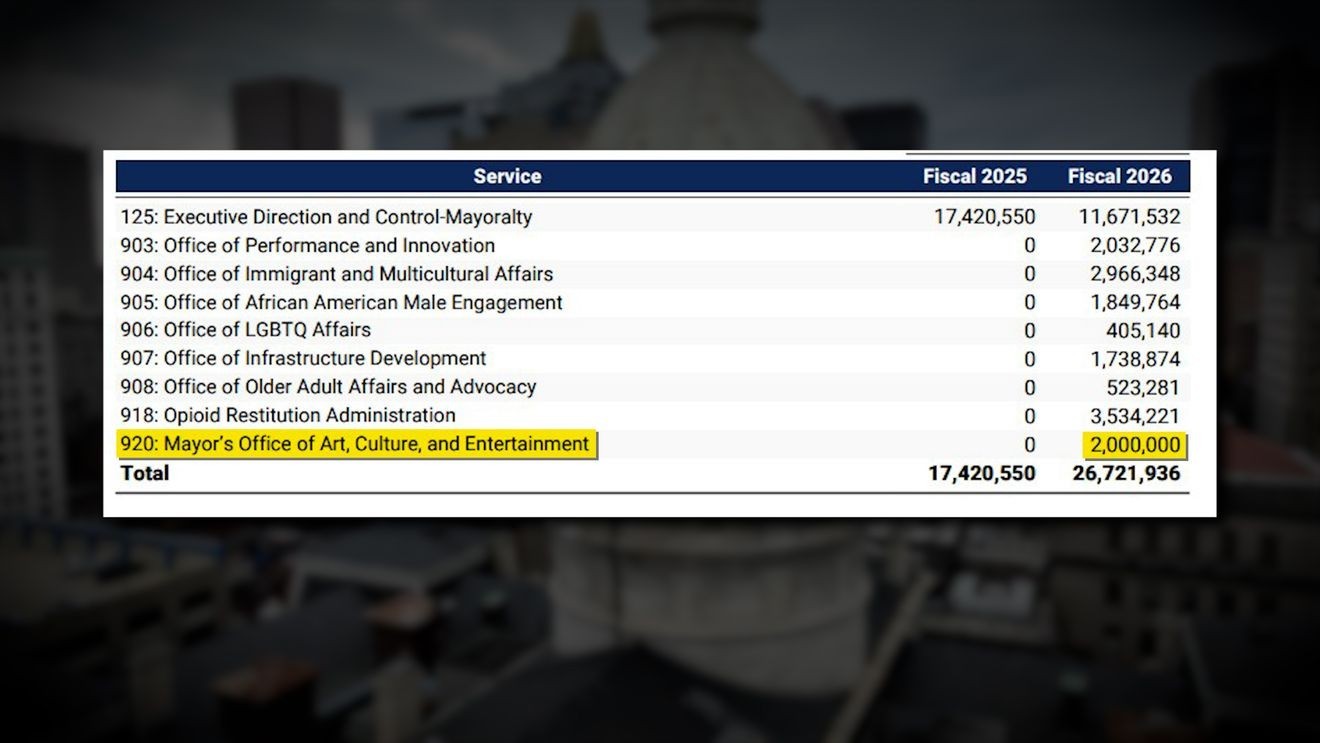
The newly established Mayor’s Office of Arts, Culture & Entertainment is entering its sixth month of operation under the current fiscal year, but no Baltimore City agency has been able to explain to Spotlight on Maryland how the office is spending its $2 million taxpayer-funded budget.
City Councilman Mark Conway said the lack of detail raises “deep concerns about accountability and documentation.”
MOACE is in charge of putting on some of the city’s largest public events including AFRAM, Artscape and Charm City Live.
Spotlight on Maryland requested a line-by-line breakdown of MOACE’s expenses from four city offices: MOACE, Mayor Brandon Scott’s team, the city budget director and the city’s law department. None of the offices contacted provided an itemized accounting. City Budget Director Laura Larsen did not respond to phone calls or emails.
After submitting a records request for the expenses, the law department told Spotlight on Maryland “no responsive documents exist.” MOACE’s $2 million budget appears as a single line item in the fiscal 2026 budget. The law department said there is an understanding the budgeting “would be built out throughout the fiscal year.” The only other note given by the law department was that the funding has been used to create five positions.
“I think it’s not acceptable,” Conway said when asked whether it is normal for a city office not to have an expense report several months into the fiscal year. “This is an office spending public dollars and you would expect to have an accurate accounting of those dollars.”
Spotlight on Maryland contacted Alissa Ferguson, strategic operations coordinator for MOACE, to ask whether her office tracks its spending. Ferguson did not answer the question, instead responding that she was adding Ahleah Knapp “to assist you.” Knapp, a paralegal specialist in the city law department, did not respond to the email chain.
Luke Spreen, an associate professor at the University of Maryland College Park School of Public Policy who researches state and local public finance, said the lack of available spending information is a bit surprising.
“Even if it’s just staff salaries, I would think they could produce a report that would say we’ve allocated this much money to salaries,” he Spreen.
Spreen said Baltimore’s budget office collects expenditure data across agencies and publishes an annual, audited financial report. But he said it is reasonable to expect departments to be able to produce interim spending information during the fiscal year.
“I found it a bit surprising they could not give you an answer,” Spreen said, noting that the issue could stem from how data are organized within the city’s accounting system, particularly for offices housed directly under the mayor. “Pulling out an individual unit is a little bit tricky.”
MOACE is one of several offices that report directly to Mayor Scott, including the Office of Performance and Innovation and the Office of Immigrant and Multicultural Affairs among others. Conway said that structure could complicate oversight.
“When you see these new mayor’s office functions created, pulling clerical duties and clerical responsibilities into the mayor’s office, in many ways, politicizes them,” Conway said. “Making those decisions and processes more proximate to the mayor.”
Conway was the only member of the 14-member City Council, along with Council President Zeke Cohen, to respond to Spotlight on Maryland’s request for an interview or statement. Each council member received the same email outlining the inability to obtain an expense report and asking what oversight mechanisms are in place.
MOACE has drawn attention before. Within the first few months of the office’s launch, senior adviser for arts and culture Tonya Miller Hall stepped down. Her resignation on Aug. 1 came as a surprise to many, given her reputation in the local arts scene and the relatively short duration of her tenure.
The office launched not long after Scott ended the city’s contract with the Baltimore Office of Promotion & The Arts in 2024, citing financial instability and management concerns. MOACE officially launched in April and assumed responsibility for several events previously overseen by BOPA, including AFRAM.
Scott has said the office is intended to support the city’s cultural workforce, creative economy, nightlife and film industry.
“If what you’re saying is true,” Conway said, referring to the lack of spending records, “then MOACE is now functioning with less transparency and accountability than BOPA.”