


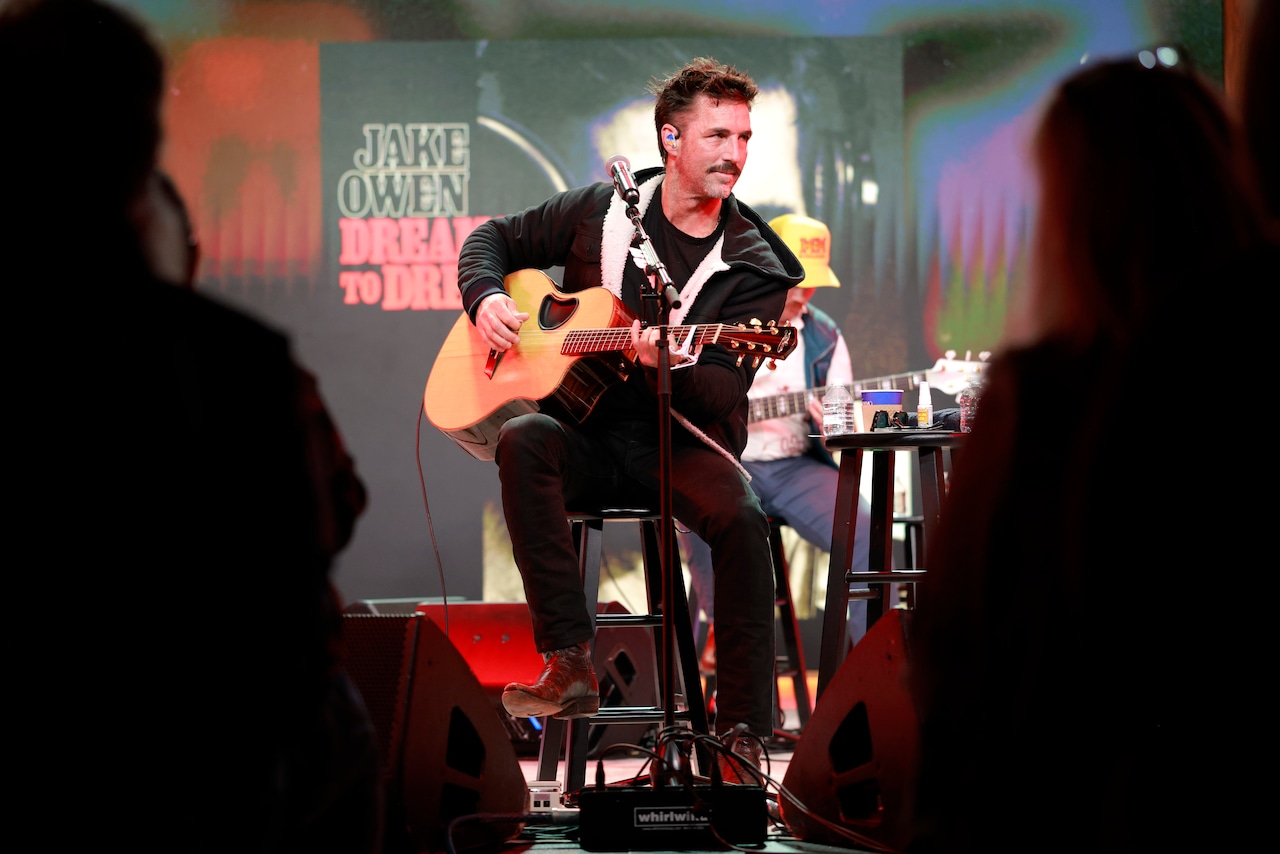
You may have underestimated Jake Owen. He’s famous for slick country hits, with titles like “Barefoot Blue Jean Night,” “Beachin’” and “Hot Truck Beer,” and his Hollywood-worthy looks. But Owen’s latest album “Dreams to Dream” reveals deeper talents.
Made with producer Shooter Jennings — who’s worked with stars ranging from Brandi Carlile and Tanya Tucker to Marylin Manson and Guns N’ Roses bassist Duff McKagan — the album exudes classic-country vibes.
On standout songs like the title track, “Long Time Lovin’ You” and “Chill of December,” Owen’s heartfelt vocals deliver lyrics reflecting on middle-age. Spectral pedal steel, cooing female background vocals and closing-time drum shuffles enhance the mix. It’s way more George Jones than bro-country.
“Dreams to Dream” is Owen’s eighth studio album and first as an independent artist. It seems like the beginning of a compelling second act for him.
“Maybe it took me going out on my own,” Owen says, “to not have other people behind me or around me trying to lead me astray from an album like this. Because most of the time people are focused on commercial success. This was really more focused about great music, and I was able to put my own money where my heart was.”
Owen and his band, featuring musicians who played on “Dreams to Dream,” are supporting the album by performing it live in its entirety.
The tour is hitting venues much more intimate than those he often performs at. For example, Huntsville, Alabama’s 1,600-ish capacity Mars Music Hall on Saturday. The last time Owen played Huntsville, about four years ago, it was at the 8,000-cap Orion Amphitheater.
On a recent morning, Owen connects from a coffee shop in Kingston Springs, Tennessee, the town where he resides, for a 15-minute phone interview. Edited excerpts below.
This record impressed me. Organic and with lots of soul and feel. You’ve had lots of success with polished hits. What led you to shift to a much rootsier sound for “Dreams to Dream”?
Jake Owen: Well, thank you first off for the compliment. You used the word “polished,” and I think that’s probably a good term for the fact that I’m 44 now and I’ve gone through an over-20-year career which has been incredible and really fulfilling for me.
I told someone the other day that I’ve done more with music than I ever thought would ever be possible. Not just with the music, but with everything that relates into it, like philanthropy and into everything else that I could have possibly ever done. I’m really truly fulfilled.
But the one thing that was not fulfilled within me was this deep desire to make a record like the one you just described. I’ve always loved that type of music, and I felt like the timing for me maybe hadn’t been right up until this point of my career, where I finally had kind of lived life. I wasn’t a 23 year old kid anymore.
Twenty years later I’m not as polished anymore. I’m more rough around the edges and honest with myself and honest with others about things I feel. And I think that comes with age.
I’m really glad that I did do that, because I’m at a place where I’m independent, which is a good cool feeling and also can be nerve wracking at times, especially in the landscape of the music industry these days. But yeah, it was just really fulfilling to finally take that step.
Shooter Jennings producing is a perfect fit for this kind of music. How did Shooter help crystalize your vision for the album in the studio?
I think that Shooter’s greatest attribute is allowing the person that’s in that room with him to be who they are. And he’s really good at convincing, he convinced me, that it’s OK not have things be perfect.
Like, let things live the way they live because that’s what’s truth and that’s what’s real and raw and honest. And that’s what I think is what has been shining through for me on this album is people are like, wow, I’ve never heard you like this before. And that’s been something that’s been really fun and comforting for me.
The song “Them Old Love Songs” featuring Savannah Conley, reminded me of vintage Muscle Shoals country-soul. “The Jukebox Knows,” with Jamey Johnson, if you’re doing honky tonk music that a great guy to chop it up with. And the song “So Long, LA” is the perfect ending for this album.
Yeah, I think to leave Nashville and go out to L.A. and make a real country album sounds interesting in itself. But it was also the same kind of parallel, it’s really weird, that when Hank [Williams, Jr.] made that album “The New South” and went to Muscle Shoals and made it with Waylon [Jennings, country legend and Shooter’s dad], I was going to L.A. and making one with Shooter.
I always loved that [1977 Williams] record. The last song on that album of Hank’s is called “Long Way to Hollywood,” and that’s where we made this album. [Laughs]
You’re a handsome guy. If you weren’t do you think your talent and music would be taken differently by some critics and fans?
Oh, man, that’s the greatest question and no one’s ever asked me that. I’ve always felt that way.
I’ll never forget when I played the “New Faces [of Country Music”] show in 2007, I think it was. Which for those that don’t know, “New Faces” is a show that’s kind of within Nashville, the country music industry and country radio, when all these artists on labels get record deals.
Country radio kind of chooses the people that they want to hear from that year to showcase their new music, and the labels really get behind it. If you get chosen to do that, it’s a big deal in that world of mainstream country radio. So it was me that year, Taylor Swift and Bo Bice, who had just been on “American Idol.”
And I just remember, there was a lady that was on Fox News at the time, I don’t remember her name, but she introduced me that day to all of country radio and everyone. And it was after Taylor Swift or whatever and she was like, “Now, y’all, give it up for this next guy. Wait till you see his smile and his hair …”
And I just remember in that moment being like, man. I mean, I wasn’t offended that she was giving me a compliment as far as, I guess, being good looking or something.
But this was in the very beginning of my career, in a moment where I was there to showcase music that I made. And actually that first record I wrote every song on it — not that every one was great.
But I just always felt like I was trying to prove myself. And I was a kid from Florida. People would always say, like, oh, what do you know about country music? You’re from Florida. Like no one knew that everybody from John Anderson to the Bellamy Brothers to you name it, all from Florida.
So anyways, great question, because there have been times where I wondered what my career would have been like if I hadn’t … I mean, I guess I’m a victim of my own deal, too. You know, there were times where I was on [the magazine] People’s “sexiest” whatever [list]. Maybe it’s hard to ignore that, when people are offering those types of things up to you, I suppose.
There’s been a part of me that’s always felt like I’ve never really been taken that seriously, if I’m being honest. I’m just like a guy they’ve accepted because I’ve worked hard enough to get in there. That does itch me sometimes, I will say. [Laughs]
But this album, for sure, “Dreams to Dream,” was my way of [saying], even though I’ve accomplished a lot of things that people would dream of, I’m still dreaming, man. I’ve still got stuff that I want to fulfill. That’s just who I’ve always been — somebody that has to fulfill something consistently. Otherwise, I feel like I’m not living.