


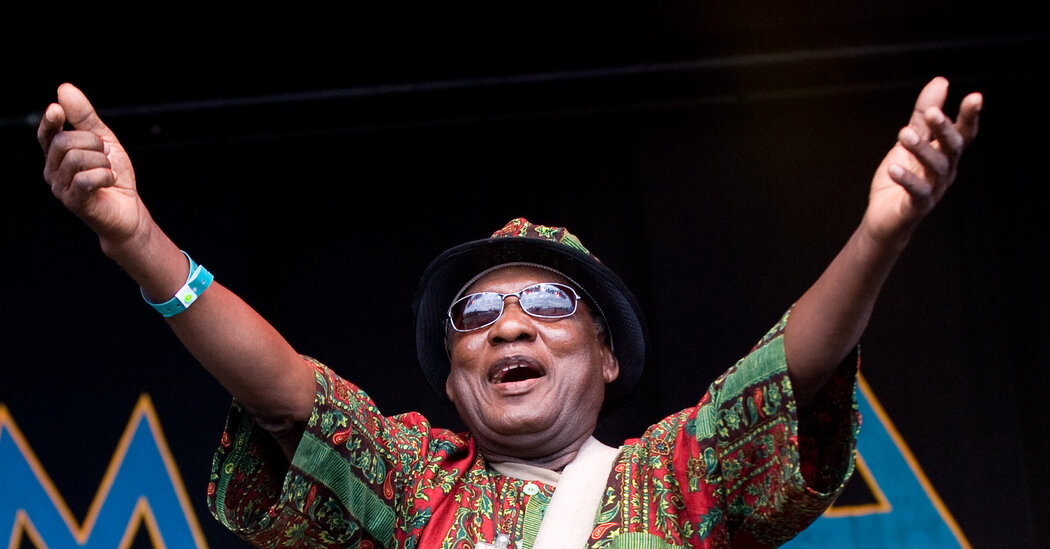
Ebo Taylor, who used the lilting rhythms of Ghana’s highlife music and the driving pulse of Afrobeat to forge a singular style that helped define West African music for a generation, died on Feb. 7 in Saltpond, a town on the coast of Ghana. He was 90.
His son Henry confirmed the death, in a hospital, a day after a festival honoring Mr. Taylor began in Accra, Ghana’s capital.
The elaborate guitar chords, two-fingered arpeggios, hypnotic rhythms and gruff, plangent vocal style that Mr. Taylor used in performing his own compositions, in Fante or English, overlaid an inherited tradition. That heritage, known as highlife, was the expression of coastal Ghana’s melting-pot culture, shaped by trans-Atlantic crosscurrents.
But highlife, the swaying, Caribbean-influenced dance music associated with Ghana’s independence in 1957 — the most famous anthem was “Ghana Freedom,” by E.T. Mensah — was only one tributary in the currents that shaped Mr. Taylor’s unusual style.
Inspired by Miles Davis, Charlie Parker and John Coltrane, Mr. Taylor “helped introduce advanced jazz chords” to Ghana’s highlife bands, John Collins, a musicologist at the University of Ghana, wrote in his 1994 book, “Highlife Time 3.”
The music that propelled Mr. Taylor to international recognition in his final years was also indebted to the traditional Akan rhythms of Ghana; the strident beat of the Nigerian Afrobeat pioneer Fela Kuti, a close friend; and even the Western classical tradition. Mr. Taylor recalled studying Dvorak’s “New World” Symphony “in detail” at the Eric Gilder School of Music in London in the early 1960s.
Thank you for your patience while we verify access. If you are in Reader mode please exit and log into your Times account, or subscribe for all of The Times.
Thank you for your patience while we verify access.
Already a subscriber? Log in.
Want all of The Times? Subscribe.