


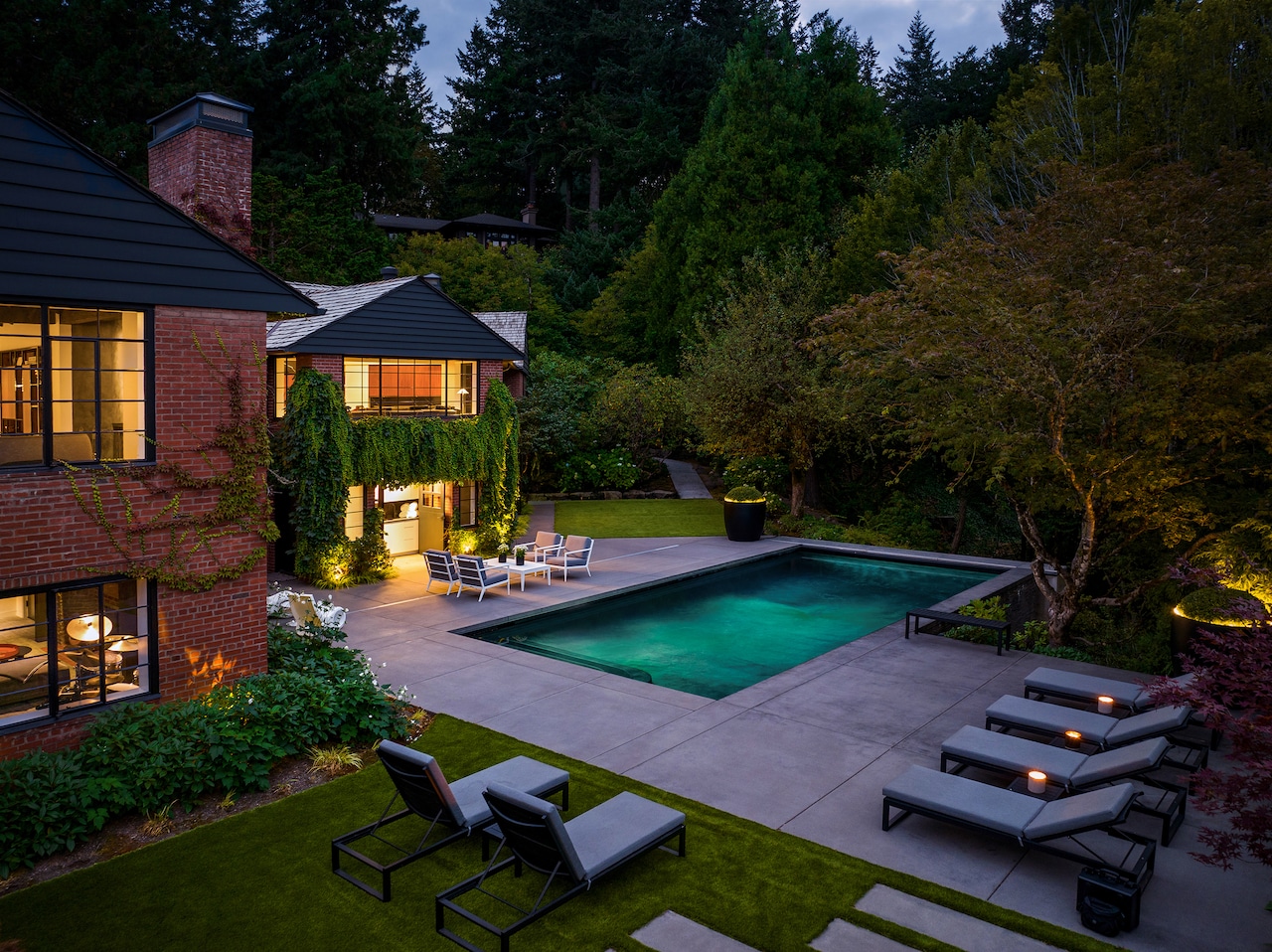
An English country-style estate for sale in Northwest Portland has a fortunate history: The almost 1.5-acre parcel was first owned by a hobby botanist who admired a lush landscape and the pleasing simplicity of natural building materials.
Today, the illuminated grounds at 7307 N.W. Penridge Road in the Forest Park neighborhood are ideal for entertaining outdoors, with views of Mount St. Helens, and topiary shrubs, perennial gardens and mature trees on upper and lower terraces.
The expansive upslope terrace has a covered dining pavilion with a kitchen, and a sunken seating area around a concrete fire pit. Doors on the lower level of the house open to seating near a brick fireplace, a saltwater pool and a turf lounge to watch lawn games.
“The landscape is inviting and the lawns and stone pathways are comfortable in high heels or bare feet,” said landscape architect Craig Kiest of Huntington & Kiest, whose venerable Portland firm was hired to enhance the landscape decades ago to relate to the scale and architecture of the historic house. “It’s such a livable house, and the garden is the same way.”
The two-story brick manor has a significant provenance as well. It was built in 1949 following a design by Oregon-born architect Wade Pipes, who is recognized for his mastery of English Arts and Crafts architecture.
The late 19th-century Arts and Crafts movement celebrated skilled craftsmanship and emphasized using natural materials like wood, glass, stone and brick to elegantly connect a home to its landscape.
Pipes embraced these hallmarks through cottage-style architecture. His contemporaries, like architect Pietro Belluschi, took similar approaches to introduce the Pacific Northwest modern style.
A recent renovation of the house for sale with interior design by Barbara Sumner integrated high-end modern elements like black steel window and door frames. “We wanted everything to be clean and minimal to take advantage of the beautiful outdoors,” said Sumner.
The renovation retained Pipes’ original design of large and small spaces, and natural materials, including the original light oak floors.
The interior fireplaces have been plastered in a smooth finish and the screens are custom mesh panels applied with a minimal track, said Sumner.
Cabinetry, shelves and paneling throughout the residence’s 7,457 square feet of living space are made of warm Oregon walnut. The stairway handrail, built-in kitchen bench seats and other accents are clad in soft, tactile leather from the Kelly Wearstler brand.
Surfaces were selected to add to the sensual experience of moving through the home, said Sumner.
“Refined, serene and entirely unique, this residence is more than a home, it’s a story meant to be lived,“ said listing broker Kendall Bergstrom-Delancellotti of Cascade Hasson Sotheby’s International Realty.
The asking price for the property is $6.5 million.
The entrance to the home has been enlarged to frame a wide glass door and glass panels. Black and white marble squares are embedded in the floor.
The vaulted living room has a marble fireplace and a walnut alcove housing a custom bar, a series of walnut boxes in iron frames.
The dining room, which has a hand-blown contemporary Bocci glass chandelier and dark mirrored wine storage, offers views of the front and back of the house.
The kitchen maintained its original footprint, and exposed ceiling beams were added to visually connect the space to the other main-level living rooms.
“Most people would want to open up the kitchen walls,” Sumner said, “but we wanted a space where the clients could settle in the morning and evening and overlook the property but still have a warm, comfortable, intimate feeling.”
The kitchen island has a Nero Marquina marble slab island under a suspended matching black marble vented hood.
The main level also has three of the home’s four bedrooms, including the primary suite. Ann Sacks’ Eros Grey marble is in the center of the headboard wall with narrow vertical walnut slats on both sides. Walnut was also used on a display wall and on the seamless closet cabinets, “creating a grand and perfect primary retreat,” said Sumner.
Glass doors in the primary suite open to the hot tub and entertaining sunspace.
Eros Grey marble covers the suite’s bathroom walls and heated tile floor. There is a solid stone soaking tub and a shower with views of the box hedge and rhododendron garden.
The main level’s back French doors, in sightline of the front doors, allow access and visibility to the backyard. “One can stop here and feel the peacefulness of the house and property,” said Sumner.
The lower level has a guest suite and office, and a family room with a grand stone-and-brick fireplace and glass doors that open to the outdoors.
There is also a wellness sanctuary on the lower level with a sauna and a workout space featuring a mural painted on the concrete wall by Montreal street artist Stikki Peaches.
A narrow hall area with concrete walls and glass doors on each end became a temperature-controlled wine cellar.
Architect Wade Pipes
The original owner of the English Arts and Crafts home was Dr. Eldon George Chuinard, a surgeon who traveled internationally for his hobby to find specific plantings to bring back to his Portland home. One was English ivy that graces the home’s front entry.
The manor was one of the final works by Wade Hampton Pipes, who died in 1961 at age 83.
Over his 50-year career, Pipes designed 70 residences, from quaint English beach cottages to large Pacific Northwest modern houses. At least 15 of his residences are listed on the National Register of Historic Places.
Pipes studied art and architecture at London’s Central School of Arts and Crafts between 1907 and 1911, before returning to Oregon to establish his architectural practice.
Historians with the National Register said that Pipes’ houses have design features that can be traced to English prototypes, but he tailored them to the Pacific Northwest environment.
The well-trained Pipes insisted on working with expert builders and selected quality local materials. He designed and supervised the manufacture of bricks from the Sylvan Brick Company in Portland.
Belluschi praised Pipes’ skill as a craftsman and designer who understood good composition and fine detailing.
“Wade Pipes was a man out of time: a free spirit living in uneasy truce with a technologically obsessed society,” observed Belluschi. “He was uncompromising in his principles and adamant in what he thought to be appropriate and beautiful.”