


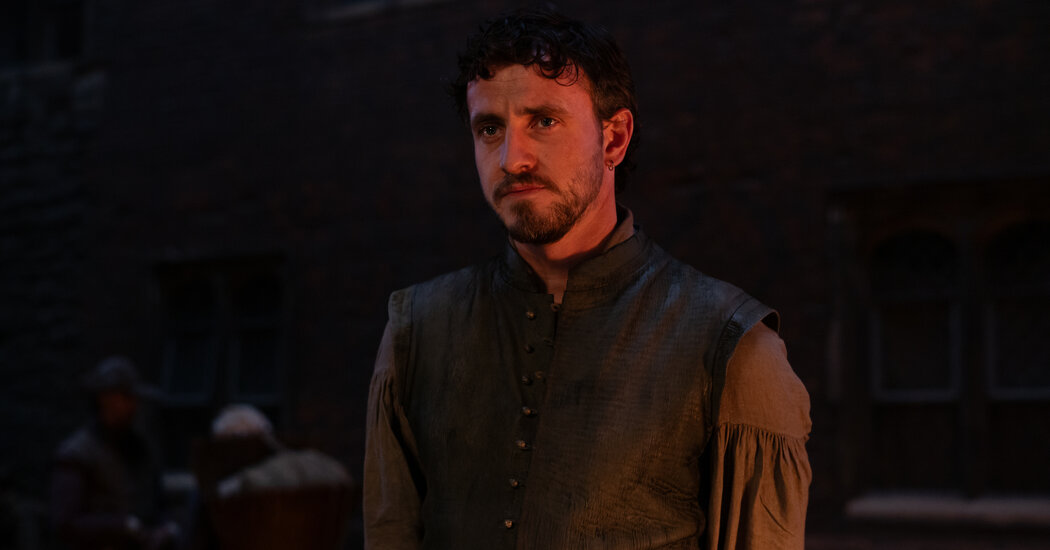
In Chloé Zhao’s drama “Hamnet,” an adaptation of Maggie O’Farrell’s 2020 novel, we encounter the most famous soliloquy in English literature twice. In the first instance, Paul Mescal, playing Shakespeare, stands on the edge of a wall at night, looking at water below in which, presumably, he might drown himself. He is bereft at the loss of his 11-year-old son, who drew his last breath before the father could arrive. Bleary with grief, the Bard gets the words out slowly, as if trying to find his way through fog: “To be … or not to be? That … is the question.” You aren’t quite sure if he’ll make it all the way through or heave himself into the sea.
Later, this contemplation reappears in a much different mouth: that of a young actor, played by Noah Jupe, who looks like a little golden god, all blond curls and clear-skinned smiles. He nears the edge of the Globe Theater stage; it is the first performance of Shakespeare’s masterwork. “To be, or not to be?” he puts to the crowd, as if it’s a bit of a philosophical question they might all ponder together.
He continues, inquisitively: “That is the question — whether ’tis nobler in the mind to suffer the slings and arrows of outrageous fortune, or to take arms against a sea of troubles, and by opposing end them.” His voice is light, his query unburdened by the great emotion that the writer of those words is feeling backstage, and that the playwright’s wife, Agnes, is experiencing as she watches the young man, who so closely resembles her lost son.
THIS SPEECH’S GREAT EMOTIONAL flexibility is among its wonders, and must have to do with its primal simplicity. The first and most famous phrase — to be, or not to be — is only six syllables long, only four unique words, each so short and easy that we learn them in the earliest weeks of literacy. The main building block of the phrase is an irregular verb, “to be,” that is both the most complicated of all verbs in English and the most common. It can be about existence, or occurrence, or the possession of a characteristic, all fundamental facts of living.
Thank you for your patience while we verify access. If you are in Reader mode please exit and log into your Times account, or subscribe for all of The Times.
Thank you for your patience while we verify access.
Already a subscriber? Log in.
Want all of The Times? Subscribe.