


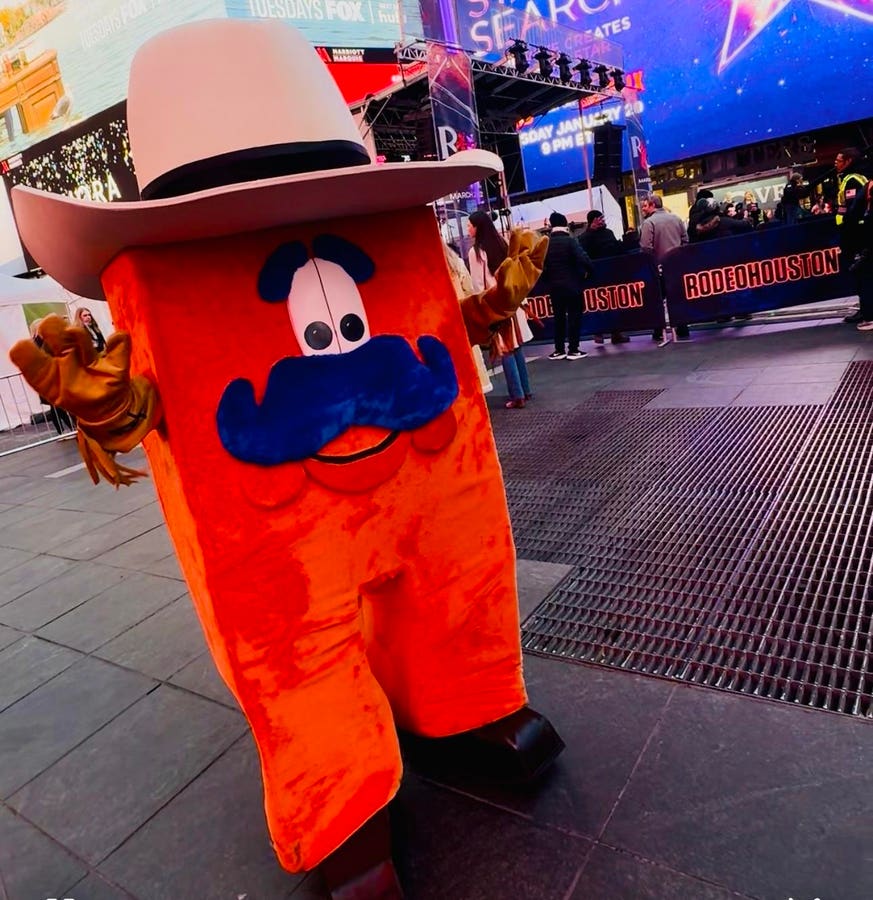
On a crisp winter afternoon in Times Square, the familiar rush of screens, traffic and bright lights paused briefly, replaced, for a moment, by something warmer. A RodeoHouston pop-up brought a burst of colour and choreography into the cold: metallic blue cowboy boots flashing across the stage, dancers moving in western-inspired rhythm, and the unmistakable texture of rodeo joy unfolding in the middle of Manhattan.
Country star Russell Dickerson stepped onto an outdoor stage for a surprise performance; dancers in sequins and blue metallic boots kicked into a rodeo line routine; and overhead, a 3D “Digital Beast” billboard bucked across the skyline, splashing orange dirt across the glass towers. This was RodeoHouston’s surprise pop-up, a Texas-sized teaser for its 2026 season, beamed into one of the most expensive advertising postcodes on the planet.
Because the Rodeo is no longer just a Texas tradition. It is becoming a destination experience.
From local stock show to experience-economy powerhouse
Independent analysis shows the 2024 event generated around $326 million in economic impact and close to $600 million in total economic activity for the Greater Houston area, with millions of visits.
Attendance is rising with it. More than 2.5 million people visited the grounds in 2024, with just over one million unique attendees; an estimated 28% came from outside the seven-county region, and visitors were recorded from 75 countries.
In 2025, the Rodeo reported a record 2.7 million guests over the event run, a reminder that in an era of streaming and on-demand everything, millions of people will still stand in line for a live, dusty, in-person show.
For the city, that is not just sentiment. Out-of-town visitors bring “new” money into hotels, restaurants, ride-shares and retail. For the Rodeo’s organisers, this is proof that what they are really selling is not tickets; it is participation in a story.
What draws them is not a single attraction, but a season-like ecosystem. The Rodeo turns NRG Park into a temporary city of experiences, arena-level music nights, rodeo competition, food and wine spaces, retail theatre and carnival magic, all layered into one navigable campus. It is the kind of environment people plan for, return to, and weave into family memory.
Global Growth Path
Behind the warm glow of the pop-up is a very cold commercial reality: RodeoHouston is a highly complex, multi-venue retail and operations machine.
Its home campus, NRG Park, spans more than 300 acres and includes 2.1 million square feet of exhibit space, with approximately 140,000 seats spread across NRG Stadium, NRG Arena and other facilities. During the Rodeo, the grass football field is removed and replaced with roughly 7,000 cubic yards of clay and topsoil, while stock are housed under the stadium bowl and the concourses are re-themed into a Western-influenced environment of bars, concessions and branded spaces.
Layered on top of that are:
• A large-scale carnival
• Commercial exhibits and shopping halls
• The World’s Championship Bar-B-Que Contest and Champion Wine Garden
• Multiple concerts with a rotating centre-stage and stadium-level production values
In other words, this is a temporary city of experiences. The Rodeo is part stadium event, part shopping mall, part food hall, part trade show. For retailers and hospitality brands, it functions as a 23-day testbed where footfall, dwell time, queue management, product mix and pricing can be observed in extremis.
The organisation’s own investments in infrastructure and venue partnerships at NRG Park run into the hundreds of millions of dollars over recent decades, and its current communications highlight not just the spectacle inside the arena but the continual upgrades to grounds, dining, bars and concourses. As more events look to emulate this model, what matters is not simply “put on a show,” but “design a campus where every step is monetised, managed and, ideally, memorable.
What Will March 2026 Bring?
As RodeoHouston looks ahead to March 2–22, 2026, there is a sense that this season has been shaped with intention rather than simply scaled for size. The re-introduced 21st programmed day, anchored by a full-length closing concert from Cody Johnson on March 22 while the wider festival environment across the grounds remains alive, reflects a shift toward experiences that sustain momentum, deepen dwell time and encourage visitors to treat the Rodeo less as a single night out and more as a cultural season to be stepped into.
That journey increasingly begins long before anyone arrives in Houston. A moment of warmth in the cold: colour, rhythm, shared joy, plants the seed of anticipation, particularly for audiences encountering the Rodeo for the first time. And when they do finally walk through NRG Park, what they meet is an environment engineered at scale: retail, hospitality, live performance, competition and community spaces working together as a living campus, turning spectacle into a sustained, human-centred experience.
As that audience widens, the expectations that travel with it evolve too. The opportunity for 2026 is not only commercial or cultural, it is to continue growing in a way that strengthens environmental responsibility, welfare standards and community value alongside international reach. Done well, that balance doesn’t constrain ambition; it reinforces trust. And so the feeling, looking toward March, is one of momentum and invitation, the spark glimpsed in New York leading toward the full warmth that still waits in Houston.